
Water heaters
Size it by your worst hour, not your bedroom count
Bedroom count is a poor guide to how much hot water a household actually needs. The number that matters is on the rating plate, and in older homes the supply pipe can be the real limit rather than the heater.
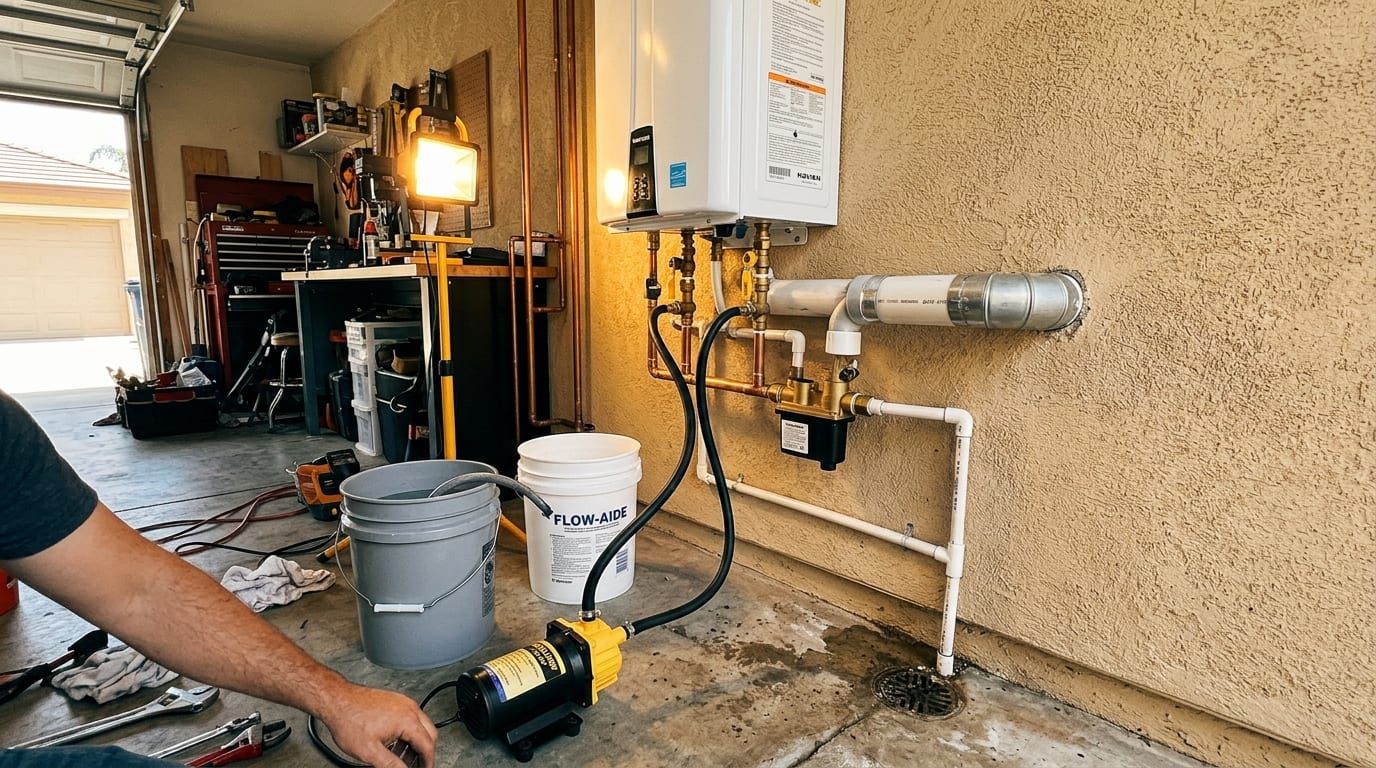
Size a water heater around the busiest hour the household genuinely has, not around square footage or bedroom count. For a tank, the figure that matters is the first-hour rating printed on the plate — how much hot water the unit can deliver in one hour starting full and hot — and it combines the stored volume with how fast the burner can reheat. For a tankless unit it is temperature rise measured against simultaneous flow. Get those right and a modest heater feels generous. Get them wrong and a large one still runs cold halfway through the second shower.
First-hour rating beats tank volume
Two heaters can hold the same volume and behave completely differently, because one has a burner that reheats the tank quickly while the other trickles. A gas tank is refilling and reheating the whole time you are drawing from it, so the useful output over an hour is always more than the stored volume, and how much more depends on the burner. This is why comparing heaters by volume alone leads people astray, and why an electric unit of the same size does not perform like the gas one it replaced. The first-hour rating is on the plate. It is the number to compare.
Map your worst hour on paper
Write down what actually overlaps in your house rather than the theoretical worst case where every fixture runs at once, because nobody lives that way and sizing for it buys a heater you do not need. The real question is how many draws happen inside the same hour, and whether they happen at the same moment or one after another. Those two situations are solved by different things.
Recovery rate rescues staggered demand
If your demand is sequential — showers one after another rather than at once — a strong recovery rate matters more than a bigger tank, because the heater is topping itself up between draws. If your demand is genuinely simultaneous, stored volume carries you through the overlap and recovery catches up afterwards. Most households are a mix, which is why the honest sizing conversation asks how the mornings actually go rather than counting bathrooms and reading a chart.
Sizing a tankless unit is different arithmetic
A tankless unit has no stored volume, so its capacity is a rate: how much water it can raise from the incoming temperature to your setpoint, per minute. Two inputs decide it. The first is the rise required, and this is where local supply helps. Costa Mesa’s water comes from wells into the Orange County groundwater basin rather than from surface reservoirs, and deep well water arrives at a steadier temperature through the year than surface supply in a cold climate does, so the required rise here is both smaller and more predictable than the same calculation performed in a snowy state. The second input is flow, and every fixture in the house has a rated flow you can find printed on it. Add the ones that genuinely run together and you have the number the unit has to meet.
Bigger is not free
Oversizing a tank has real costs beyond the appliance. A larger tank loses more heat while standing idle, occupies more floor, may not pass through the closet door, may need the gas line reviewed for the higher input, and still needs its two seismic straps anchored into structure and a pan underneath it. In a hall closet the physical dimensions frequently settle the question before the hot water arithmetic gets a look in. Measure the opening and the space before falling in love with a model.
Where the pipe, not the heater, is the limit
Costa Mesa’s median build year is 1972 and a good share of the housing stock is older than that again. Homes from before 1960 were plumbed in galvanised steel on the supply side, and galvanised corrodes inward, so the bore narrows over decades until the pipe delivers a fraction of what it did when it was new. A household in that situation reports weak, disappointing showers and reasonably concludes the heater is too small. Fitting a larger heater behind a restricted pipe changes nothing at all, because the restriction is downstream of the appliance. Put a gauge on the water and check flow at the fixtures before anybody sizes up. If the pipe is the fault, that is the conversation to have, and it is a different job entirely.
Households where the standard answer changes
What to have ready before the sizing conversation
One last check before concluding the heater is too small. If the current unit is a reasonable size and still runs out, size may not be the fault at all. A broken dip tube dumps cold water straight into the top of the tank, a thick sediment bed steals usable volume from the bottom, and a thermostat set lower than anyone realised imitates an undersized heater perfectly. All three are smaller jobs than a replacement, and all three are worth ruling out first.