
Water heaters
Six checks before you replace a water heater
A heater that has stopped making hot water is not automatically a heater that needs replacing. Work through these six checks in order and you will usually know whether you are looking at a part, a setting, or a tank that has reached the end.
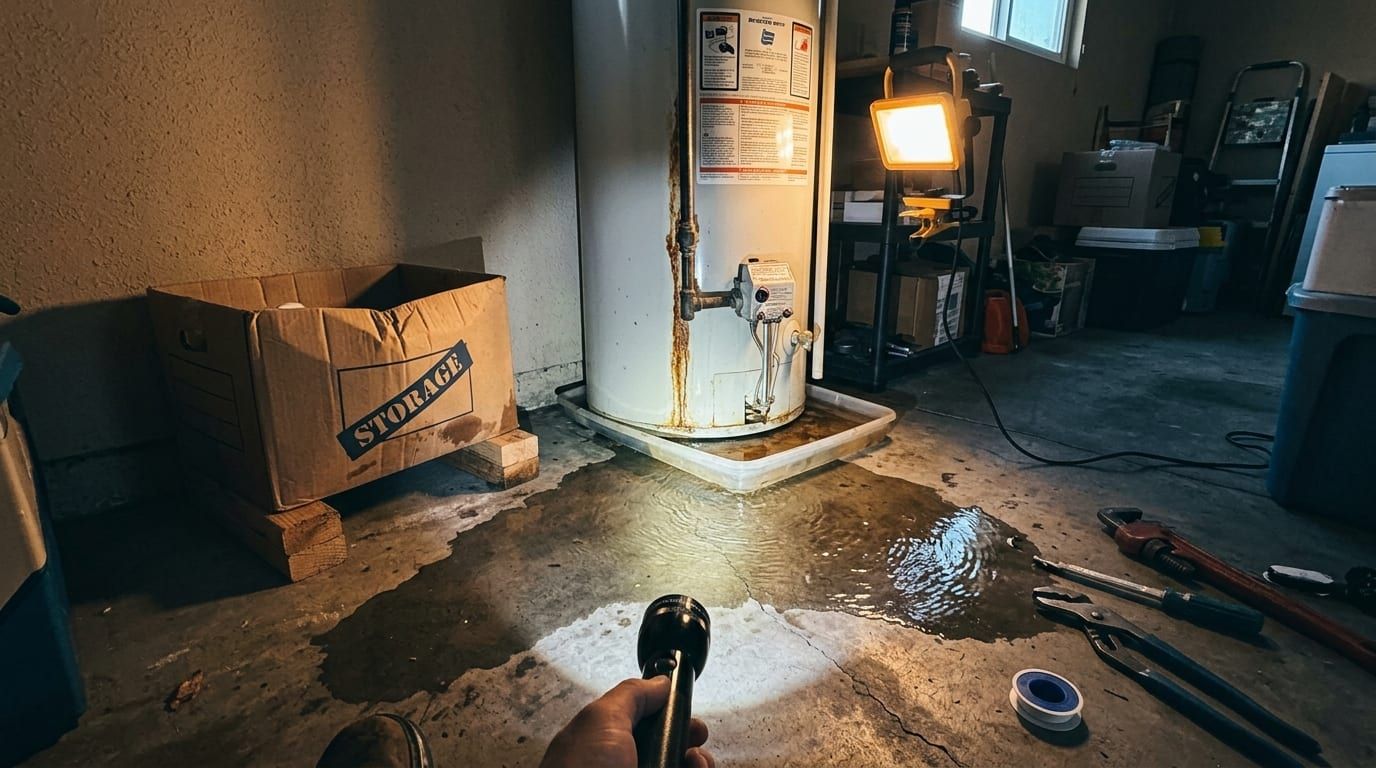
Start here, in the first minute
If there is no hot water anywhere in the house, the fault is at the heater or its supply. If it is one fixture only, the heater is fine and the problem is that fixture’s valve or cartridge. If the water is warm but never hot, or hot for a short while and then cold, the tank is working but something inside it is not. Those three symptoms lead to three different places, so name yours before touching anything. On an electric heater the single most common fix is a reset button that has tripped. On a gas heater it is a pilot that has gone out.
Check the free ones first
Check 1 and 2 on a gas heater: pilot, thermocouple, gas control
If the pilot is out, relight it by the instructions on the label. If it lights and holds, something blew it out and it is worth finding out what. If it lights while you hold the button and dies the moment you let go, the thermocouple or flame sensor is not proving the flame and needs replacing. That is a part, not a heater.
If the pilot will not light at all, or lights and the burner still never fires, the gas control valve on the front of the tank is the next suspect. Before condemning it, look underneath. Sealed-combustion heaters draw air through a screen at the base, and a garage full of lint, dust or cardboard can starve that screen until the unit locks out. Cleaning it costs nothing. Also check the flue: a vent connector that has slipped out of the draft hood, or a bird’s nest at the top, will cause repeated shutdowns and is a safety matter rather than a nuisance.
Check 3 and 4 on an electric heater: the reset, then the elements
Behind the upper access panel, under the insulation, is a small red reset button on the high-limit switch. If it has popped, push it in. If it pops again within a day, do not keep resetting it. It is telling you that a thermostat is stuck closed or an element is shorted, and repeated resets on a runaway element is how tanks end up overheating.
Elements fail in a way that tells you which one. No hot water at all usually means the upper element or upper thermostat, because the upper section controls whether the lower one ever gets a turn. A small amount of hot water followed by cold usually means the lower element is dead and only the top of the tank is being heated. Both are replaceable parts, and both are worth testing rather than guessing.
Check 5: warm, but never properly hot
Set the thermostat correctly and still get lukewarm water, and you are usually looking at one of three things. A broken dip tube lets incoming cold water dump at the top of the tank instead of the bottom, so it mixes straight into the outlet. A thick sediment bed reduces the volume of water the tank can actually hold and insulates the burner from it. Or there is a crossed connection somewhere, most often a failed single-lever cartridge or a mixing valve that is letting cold bleed into the hot side.
There is a quick test for the crossed connection: shut the cold supply off at the top of the heater and open a hot tap. If water keeps running, cold is getting into the hot piping somewhere in the house and the heater is not your problem at all.
Check 6: hot at first, then cold too soon
Short hot water is a capacity problem or a mixing problem. Sediment takes up room that used to be water, which is the slow version. A dip tube that has cracked near the top is the sudden version, and it often arrives with white plastic flecks in the aerators. On a house with a recirculation loop, a failed check valve lets the loop drag heat out of the tank continuously, so the burner runs all day and you still run out. Turning the pump off for an afternoon is a cheap way to test that theory.
When it is not the heater at all
Two things imitate a failing heater convincingly. The first is a thermostatic mixing valve on the outlet, fitted to temper the water leaving a hot tank, which drifts out of adjustment and quietly limits the whole house. The second is the anti-scald limit stop inside a shower valve, which moves when a cartridge is replaced and caps that shower alone. Neither is visible from the garage, which is why the fixture-by-fixture test in the first minute is worth doing properly.
When repair stops making sense
A part is worth fitting to a sound tank. It is not worth fitting to a tank that is weeping at a seam, rusting at the fittings, or so heavy with sediment that the drain valve will not pass water. Costa Mesa runs on local groundwater from the Mesa Water District wells, which means mineral, which means every tank here lives on a clock set by scale and by the condition of its anode rod. Both have their own articles on this site.
One last thing worth saying plainly: no hot water is uncomfortable, not dangerous, and most of the time it can wait until morning. A gas smell, water on the floor, or a relief valve discharging cannot. Our line is answered by a person at any hour, on (949) 520-6328, if you are not sure which of those you have.