
Water heaters
What a tankless conversion actually involves
A tankless unit is not a like-for-like exchange for a tank. The gas supply, the venting and the maintenance schedule all change, and on water pumped from local wells one of those changes is not negotiable.
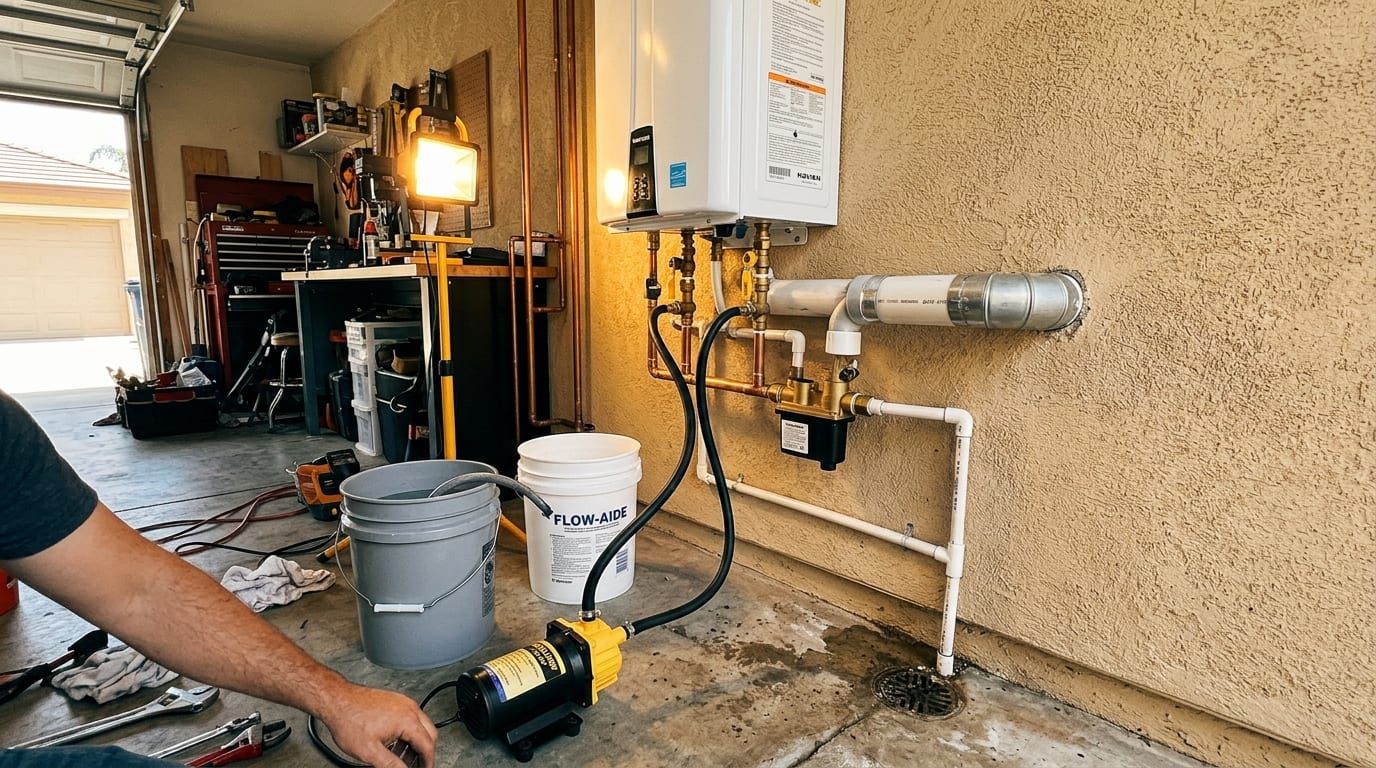
Going tankless is a conversion, not a swap. In most Costa Mesa homes it means the gas supply gets calculated and often re-run, the old flue is abandoned in favour of the manufacturer’s sealed venting through a wall or roof, a condensate drain is added if the unit condenses, isolation valves are fitted so the heat exchanger can be flushed, and the whole thing is permitted. What you get is hot water that does not run out and a unit on the wall instead of a tank on the floor. What you have to accept is a maintenance schedule that is not optional on this water.
The gas line decides whether the project is simple
A tank heater sips gas slowly and stores the result. A tankless unit makes hot water on demand, so its burner input is several times larger, and the whole of that demand appears the instant somebody opens a tap. The line that fed the old tank is frequently too small to carry it. The question is not only the pipe at the appliance either — it is the diameter and length of every section back to the meter, plus every other appliance drawing from the same run. Sometimes the answer is a short upgrade near the unit. Sometimes it is a fresh run from the meter, and occasionally the meter itself turns out to be the limit. This gets worked out with a load calculation beforehand, not discovered on installation day.
The old flue does not get reused
Sealed combustion appliances vent through the material the manufacturer specifies, terminating at a wall or roof with required clearances from windows, doors and air intakes. Two things follow from that. The first is that a sensible termination point has to exist, which is why a closet in the middle of a house can make a conversion awkward. The second catches people out: if the old tank shared a chimney with the furnace, taking the tank away leaves the furnace alone on a flue that was sized for two appliances. That orphaned furnace has to be assessed on its own, and the assessment belongs to the tankless job rather than arriving later as a surprise.
Scale is why maintenance is not optional here
Mesa Water District draws the city’s supply from nine wells into the Orange County groundwater basin, across an eighteen square mile service area that also takes in part of Newport Beach and some unincorporated county land. Groundwater carries mineral. A storage tank copes with that for years by letting deposit fall to the bottom of the vessel, out of the water path. A tankless unit has no bottom for it to fall into. Water passes through a narrow heat exchanger at high temperature, which is precisely the condition that drops mineral out of solution, and the deposit forms on the walls of the passage the water has to travel through. The result is restricted flow, reduced output, error codes, and eventually a failed exchanger.
What descaling involves
A small pump and a bucket are connected to the service valves either side of the unit and a descaling solution is circulated through the exchanger until it runs clear. The inlet filter screen is cleaned at the same visit and combustion is checked. It is an appointment, not a day’s work. The part worth underlining is the valves: a tankless unit installed without isolation valves cannot be flushed without cutting into pipework, which in practice means nobody ever flushes it.
Where the unit goes
Exterior wall mounting avoids interior venting altogether and suits this climate, though an outdoor unit still needs power for its freeze protection and should not be left unpowered through a cold snap. A garage wall near the gas meter is often the shortest route for both gas and vent, which keeps the work contained. An interior closet is possible, and it is also the location most likely to add work through venting routes and condensate disposal.
The wait for hot water does not get shorter
A tankless unit removes the limit on how much hot water you can have. It does nothing at all about how long the hot water takes to arrive. If the far bathroom of a single-storey house is a long run from the garage, that run still has to be pushed through before anything warm reaches the tap, and some units take a moment to fire and stabilise on top of that. Recirculation is the answer where it matters — either a dedicated return line, which is straightforward where plumbing is accessible and difficult in a slab house where the pipe is buried, or a crossover valve at the furthest fixture that borrows the cold line as a return. Units with a built-in pump and a small buffer volume exist for exactly this reason. Settle it before installation, because adding it afterwards is a second job.
Rebates, and the figures people quote at you
Treat any rebate figure a salesperson quotes as a claim to be verified rather than a fact. Eligibility depends on the specific model, on how it is installed, and on the programme rules as they stand that week, and programmes open and close. Check it yourself, directly with whoever runs it, before it influences the decision. One local confusion is worth clearing up while we are here: Costa Mesa Sanitary District does run a rebate programme, but it covers a CCTV video inspection of your sewer lateral or the installation of a ground-level cleanout. It has nothing to do with water heaters, and the two get mixed up more often than you would think.
When tankless is the wrong answer
Permitted work, city or county
A conversion is permitted through the Costa Mesa building department, or through Orange County if the property sits on unincorporated land such as North Tustin, Rossmoor or Ladera Ranch. Inspection covers the gas work, the venting and the rest of the install, which is the strongest argument against having one done without a permit. Gas sizing is the element most likely to be got wrong and the element that benefits most from a second pair of eyes.
Three questions before you commit
Ask for the gas load calculation in writing. Ask where the vent will terminate, then go outside and look at that spot yourself. Ask whether isolation valves are included in the price you have been given. Those three answers separate a conversion that will still be working well in a decade from one that becomes somebody else’s problem in a few years.