
Emergency plumbing
Your water heater is leaking. What now?
A water heater holds forty or fifty gallons and sits on a slab a few feet from everything you store in the garage. Knowing which kind of leak you are looking at is the difference between a repair and a clean-up.
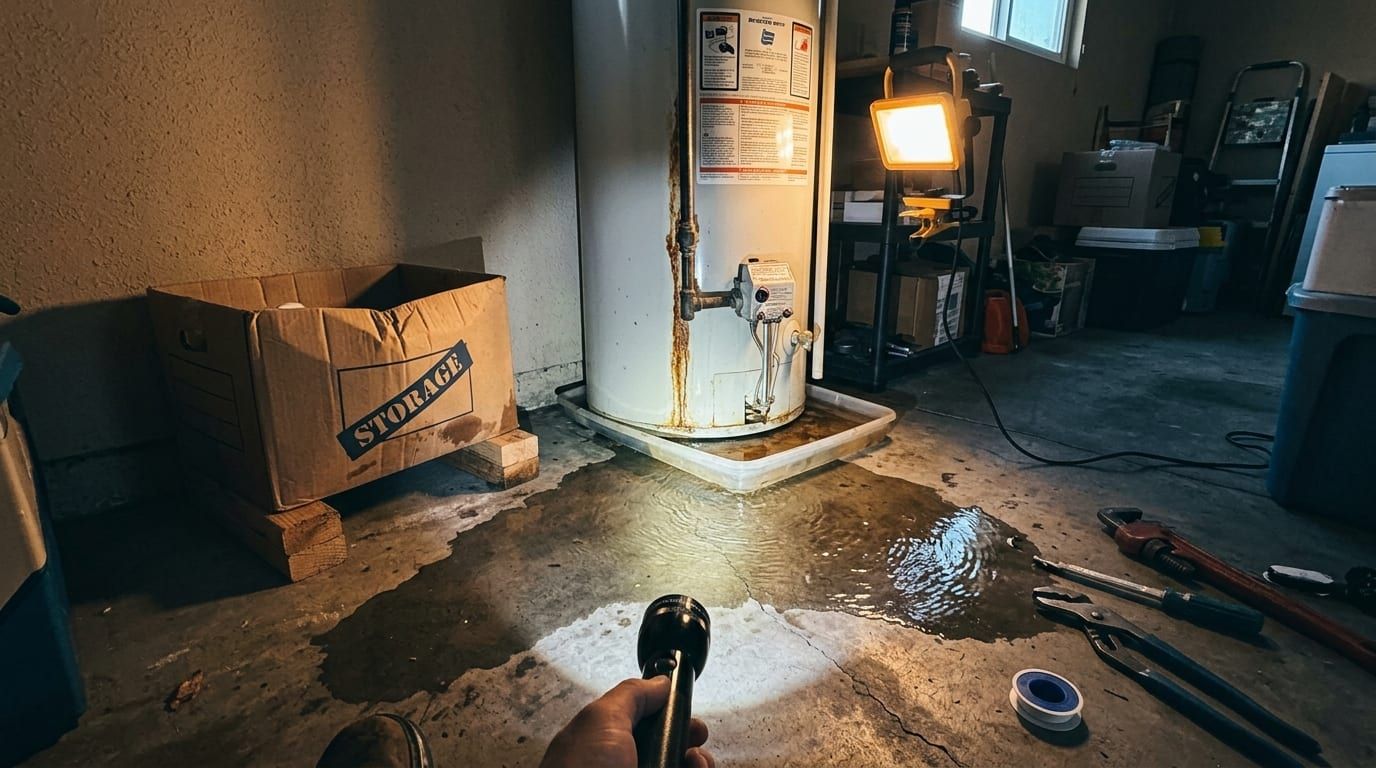
Shut it down in this order
On a gas heater, turn the gas control knob to off. On an electric one, switch off its breaker. Do that first: a tank that keeps firing while it empties can damage the element or the burner assembly and turns a leak into a replacement.
Then close the cold water inlet valve on top of the heater — the handle on the pipe entering the tank. That stops the tank refilling. If that valve will not turn, close the main at the meter box instead.
Only then worry about the water on the floor. Move what is stored nearby, because cardboard on a wet slab collapses faster than anyone expects.
Where is it leaking from?
From a fitting at the top — usually repairable
Water at the inlet or outlet connections, at the nipples or at a flexible connector is a repair. The tank itself is intact, and the failure is a joint that has corroded or loosened.
From the relief valve — investigate, do not cap
The temperature and pressure relief valve is a safety device. If it is weeping, either the valve has failed or the system is telling you the pressure or temperature is too high — often a failed pressure regulator or a missing expansion tank. Whatever the cause, that valve is never capped, plugged or valved off.
From the bottom of the tank — not repairable
Water appearing under the tank with dry fittings above means the steel has corroded through. There is no repair at any price, and the failure accelerates: what starts as a damp line across the slab becomes a steady flow. The only question left is what replaces it and how soon.
Why they fail early on Costa Mesa water
Mesa Water District supplies most of this city entirely from local groundwater. Groundwater carries mineral, and inside a tank that mineral settles as sediment, insulating the burner from the water it is meant to heat. That is what the rumbling noise is, and it makes the heater work harder for the same result.
The other consumable is the anode rod — a sacrificial metal rod that corrodes so the tank does not. Once it is spent, the tank itself becomes the sacrificial part. Flushing the tank and checking the anode partway through its life is the cheapest maintenance in the house, and almost nobody does it.
What a compliant replacement includes
A changeout is permitted work, and the inspection covers more than the appliance itself:
Emergency tonight or booking tomorrow?
If you can close the cold inlet and the water stops, you have bought yourself the night. The tank is finished either way, but a controlled replacement in daylight is better work than a rushed one at 2am.
If the inlet valve will not close, if water is reaching electrics, or if the garage is filling faster than you can move things, that is a call now rather than in the morning.
What gets checked before anyone talks about a new tank
A gauge goes on a hose bib before a replacement is discussed. Static pressure on the incoming supply is the number that explains a weeping relief valve, and it decides whether the next heater lasts or repeats the failure of this one. A regulator that has drifted high, or a closed system with no expansion tank, will work a new tank exactly as hard as it worked the old one.
After the gauge: the gas line and where it branches, the vent run and its slope, whether the pan drain terminates somewhere useful, and the clearance around the appliance. Half the reason a changeout is more than an appliance swap is that everything around the heater has to be right before the heater can be signed off.
Tank or tankless on Costa Mesa water
Mesa Water District draws this city’s supply from local wells, and that water carries mineral. Mineral decides this question here more than fuel type does. In a tank it drops out and sits on the bottom as sediment. In a tankless heat exchanger it plates onto the hot surfaces the water passes over, and a scaled exchanger loses output before it starts short-cycling.
That does not make tankless the wrong answer. It makes descaling a scheduled job rather than an optional one, and it makes isolation valves at the unit non-negotiable, because without them a descale means cutting into pipework. Gas and venting belong in the same decision: a tankless unit asks for far more gas at peak than a tank does, and it needs its own vent and a route for condensate. A house plumbed and vented for a tank can need real preparatory work first, and that work belongs in the comparison rather than in a surprise halfway through.
What the noises and the symptoms are telling you
Ten minutes with a torch
Find the rating plate and read the serial number. Most manufacturers encode the month and year of manufacture in it, though the scheme differs by brand, and that gives you the heater’s real age rather than the age of the house. Then check the straps: two of them, upper third and lower third, anchored into structure rather than drywall. Then follow the relief line from the valve to its end, looking for full size all the way, a downward run, a termination near the floor, and nothing resembling a valve in it.
Last, put the torch on the slab rather than on the tank. A dried mineral trail across concrete is the record of a leak that has already happened and stopped, and it is the earliest honest warning a tank gives before the day it gives none at all.
Permits, and who signs the work off
A water heater changeout is permitted work. In Costa Mesa that runs through the city building department; on unincorporated Orange County land, which includes North Tustin, Coto de Caza, Ladera Ranch, Rossmoor and Rancho Mission Viejo, it runs through the county instead. The permit is what puts an inspector on the straps, the pan, the relief line, the venting and the expansion tank, and it is why none of those is an optional extra.
It matters later as well. An unpermitted heater becomes a line item when the house is sold, and doing the paperwork afterwards usually means doing the work twice.