
Emergency plumbing
What to do in the first ten minutes of a plumbing emergency
Nobody reads a guide while water is spreading across the floor. Read this one now, find your shutoff while nothing is wrong, and the night it happens you will already know the first three moves.
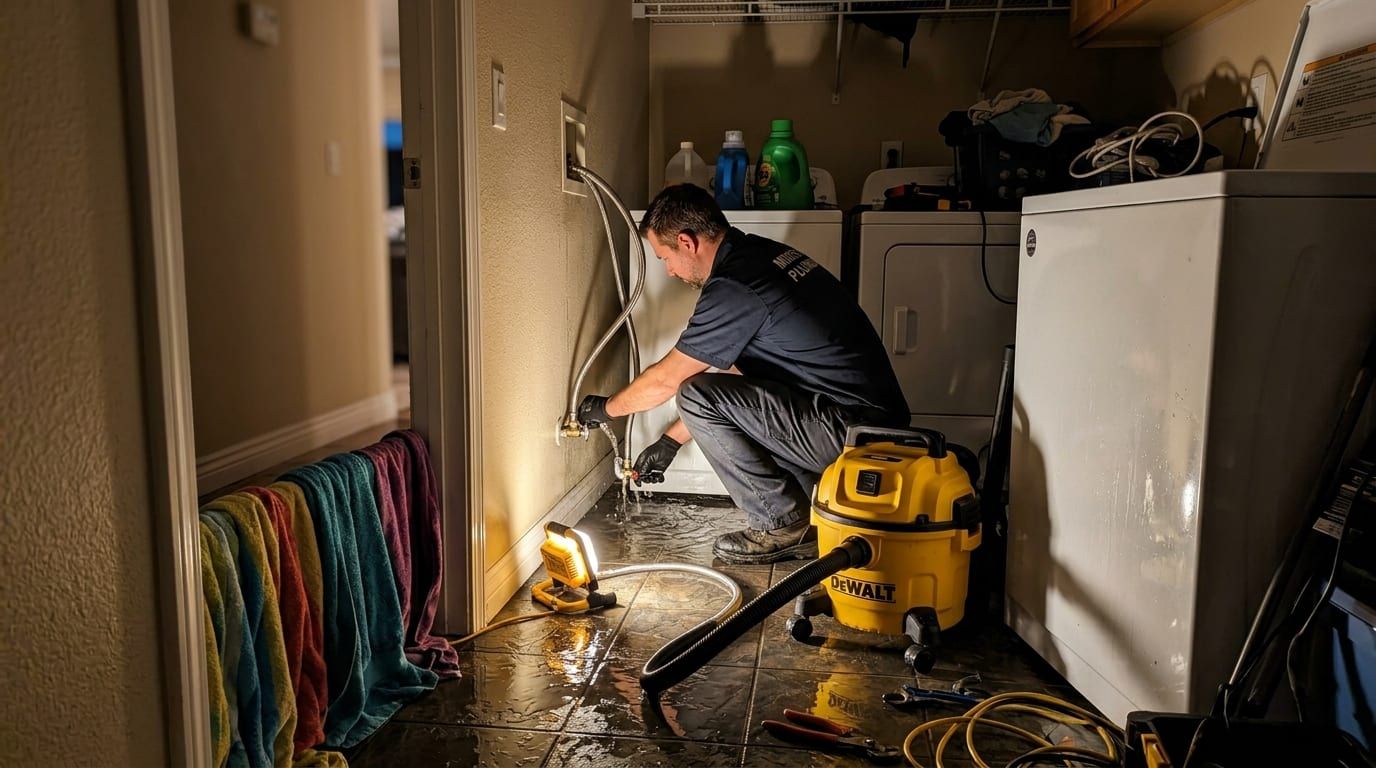
Stop the water before anything else
Everything else on this page is secondary. Water that is still arriving makes every other decision worse, so the first move is always the same: close the valve. In most Costa Mesa homes there are two you can use. The angle stop under a fixture shuts off that fixture alone, and the main valve at the meter box in the parkway shuts off the whole house.
The meter box is the rectangular lid set in the grass strip between the pavement and the kerb. Lift it, and inside you will see the meter and a valve on the street side of it. A quarter turn until it sits across the pipe closes it. Some older valves need a meter key, which is a cheap tool worth owning before you need it.
If the valve will not move, do not force it until it snaps. Tell us on the phone — a seized main valve changes what we bring and how fast we need to be there.
Kill the power to anything the water can reach
Water on a garage slab reaches extension leads, tool chargers and the water heater. If the leak is at or near an electric water heater, switch off its breaker before you go near the tank. On a gas heater, turn the gas control to off.
If water is coming through a ceiling, stay out from under it and switch off the lighting circuit for that room at the consumer unit. A ceiling holding water is heavier than it looks, and the fitting in the middle of it is a live socket full of water.
Give the water somewhere to go
Once the supply is off, the water already in the system still has to drain. Open the lowest taps in the house — usually a bath or an outdoor hose bib — and let the pipes empty downward rather than into the room you are standing in.
For a sewer backup the opposite applies: stop putting water into the system entirely. No taps, no washing machine, no dishwasher, and nobody flushing. Every litre you add comes back up at the lowest fixture.
What to tell us when you call
A useful call takes thirty seconds and changes what arrives at your door. What we need is simple:
What not to do
Do not pour chemical drain cleaner into a line that is already backed up. It sits in the standing water, it does not clear the blockage, and it makes the line dangerous for whoever opens it — including us.
Do not run the garbage disposal to “push it through” a blocked kitchen line. You are adding solids to a pipe that cannot move what it already has.
Do not keep flushing a toilet that has not drained. The second flush is the one that puts the water on the floor.
Why Costa Mesa houses fail the way they do
Two thirds of the housing in this city was built before 1980, with a median build year of 1972. That single figure explains most of our night calls. Houses of that era were plumbed with copper supply and cast-iron waste, and both are now at the age where failures are predictable rather than random: a pinhole in slab copper, an angle stop that gives up the first time it is turned in twenty years, a cast-iron kitchen branch that has finally closed.
The other local detail worth knowing is who owns what. The Costa Mesa Sanitary District treats your sewer lateral as private all the way to its main, usually under the middle of the street — so a break in the parkway is still yours. That is why a camera inspection before a problem is worth more here than most people assume.
The five minutes that make the next emergency easier
Find your meter box and check the valve turns. Find the shutoff where the supply enters the house. Look under each sink and at the toilet and note where the angle stops are. Put a meter key wherever you keep the torch. That is the whole exercise, and it turns the worst ten minutes of a plumbing failure into a manageable ten.
Where the house shutoff hides, by the era it was built
The meter valve is the one everybody should know, but the valve inside the property line is the one that saves your kitchen while the rest of the house keeps running. Where it sits depends on when your street went up. In the oldest Eastside Costa Mesa cottages there is often nothing between meter and fixtures. In the 1960s and 1970s tracts, Mesa Verde included, look for a gate valve where the supply comes up through the garage slab or on the wall near the water heater. Newer houses have a quarter-turn ball valve in that position, and a home plumbed in PEX to a manifold has labelled ports that isolate one bathroom and leave the rest running.
Whichever you have, turn it twice a year so it stays turnable. Gate valves are the ones that let people down: the stem can part from the gate inside the body, so the handle spins freely while the water keeps arriving. If the handle never gets stiff and the taps still run, that valve is not shut. Go to the meter.
What to do in the wait, and what to leave alone
Once the supply is off, the job is limiting what the water already inside can ruin. None of it needs a tool.
If the water is coming back up, find the cleanout
A sewer emergency turns on one question: is there a cleanout, and can somebody reach it. The cleanout is a capped pipe at ground level, outside near where the waste line leaves the house, often behind a shrub that has had thirty years to grow across it. With one, the line can be opened, filmed and cleared from outside. Without one, access comes from a pulled toilet or the roof vent, both slower at two in the morning.
Go and look for yours on a dry afternoon, and if it is buried, dig the cap clear and leave it visible. If there is no cleanout at all, the Costa Mesa Sanitary District runs a rebate covering the installation of a ground-level one, and another for a camera inspection of the lateral. Ask the district what applies to your address.