
Emergency plumbing
The water pressure dropped. Where to look, in order
Pressure problems get misdiagnosed more than anything else in this trade, because the symptom is at the tap and the cause almost never is. Four questions narrow it down fast.
Question one: everywhere, or one place?
Walk the house and open taps. If one fixture is weak and everything else is fine, the problem is at that fixture: an aerator packed with mineral, a partly closed angle stop, or a cartridge that has failed. Unscrew the aerator, rinse it, and a surprising number of “pressure problems” end there.
If everything in the house is weak, the cause is upstream of all of it — the supply pipe, the regulator, or the water arriving at the property.
Question two: hot, cold, or both?
Weak hot water with normal cold points at the water heater rather than the plumbing. On local groundwater, sediment builds inside the tank and can restrict the outlet; on a tankless unit, scale inside the heat exchanger does the same thing.
Weak on both sides is a supply-side problem and the heater is not involved.
Question three: sudden, or gradual?
This is the most useful question of the four, and the hardest for a household to answer honestly, because gradual change is invisible from inside.
Sudden loss usually means something discrete: a valve knocked partly closed, a failed pressure regulator, a break in the service line, or work on the street main. Ask a neighbour — if their pressure dropped at the same time, it is not your house.
Gradual loss over years, in a house built before about 1960, is the classic signature of galvanised steel supply pipe corroding from the inside. The bore closes a little every year. Nobody notices until a visitor mentions the shower, or until the day the pressure finally becomes unusable.
Question four: what does the gauge say?
A pressure gauge that screws onto a hose bib settles the argument in two minutes. Read it with everything in the house closed, then again with a tap running.
A low static reading points at the regulator or the supply. A high static reading is its own problem: pressure above what fixtures are designed for shortens the life of every connector, valve and appliance in the building, and it is why several fixtures start dripping in the same month. A reading that collapses the moment one tap opens points at a restriction — narrowed pipe or a partly closed valve.
The pressure regulator, which nobody thinks about
Most Orange County homes have a pressure-reducing valve where the supply enters the property, usually near the meter or on the street-facing wall. It is a mechanical device with a spring and a diaphragm and it wears out.
When it fails low, the whole house goes weak. When it fails high, the house is silently over-pressured. Either way it is a discrete part with a defined job, and replacing it is a far smaller intervention than the repipe people fear when they hear “whole house pressure problem”.
When it really is the pipe
In a pre-1960 house with original galvanised supply, three symptoms usually arrive together: pressure that has fallen over years, rust colour on the first draw after a quiet night, and a history of pinhole repairs. Any one of them alone is not a repipe. All three together are the pipe telling you it is finished.
A repipe is planned around access points — attics, closets, cabinet backs — rather than driven through walls, so the number of openings is far smaller than people imagine, and everything opened is patched. On a single-storey Orange County house it is a small number of days with the water back on each evening.
No water at all is a different problem
Weak is a diagnosis. Nothing at all is an emergency, particularly if anyone in the house is elderly, unwell or caring for a baby. Check the meter first: if the dial is spinning with everything closed, water is escaping between the meter and the house. If the meter is still and nothing arrives, the loss is upstream.
Either way, tell us what you found when you call. Those two observations — meter moving or still, neighbours affected or not — cut the diagnosis in half before we arrive.
The order it gets worked through on arrival
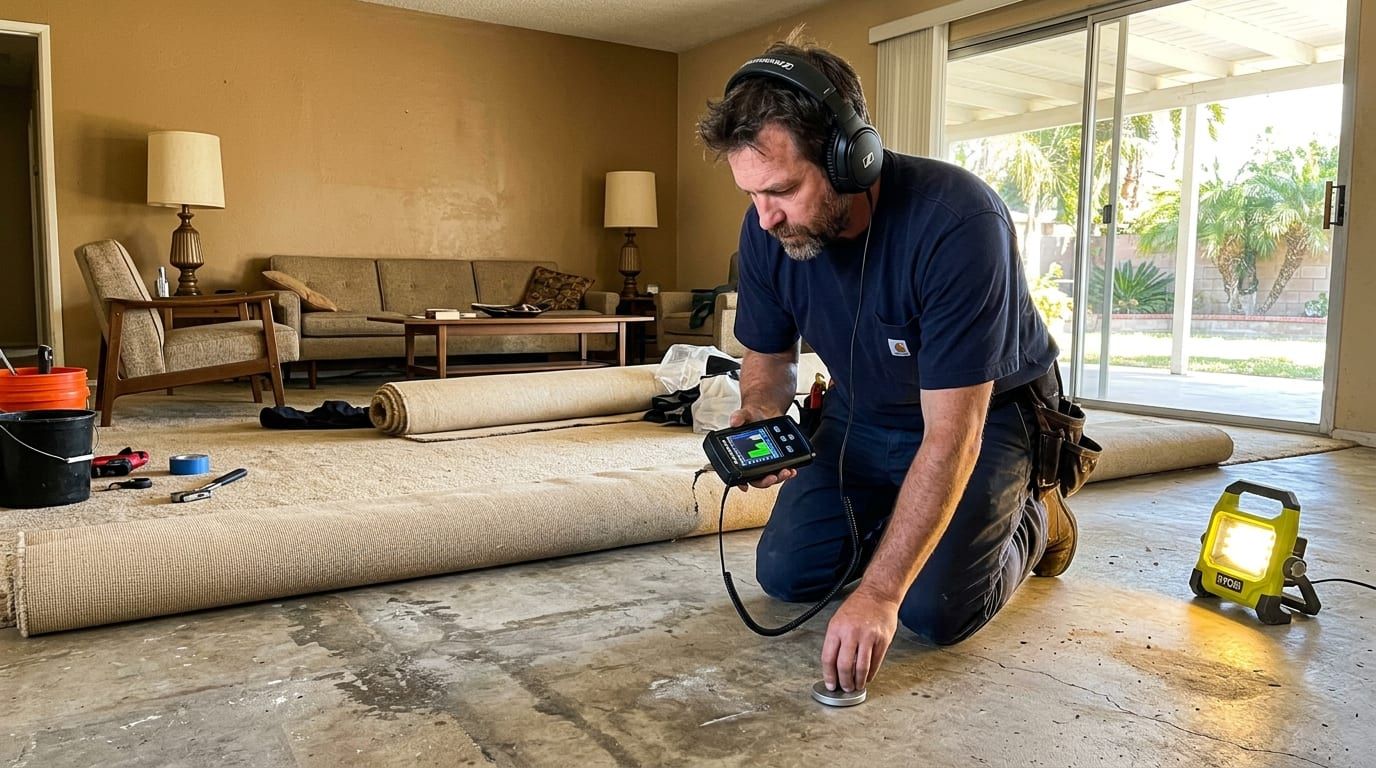
The first thing out of the van is a gauge, not a wrench. A static reading at a hose bib with the whole house closed, then a second reading with a bath filling, gives two numbers that between them rule out most of the possibilities before a fitting is touched.
Then it is a walk of the valves and a comparison of ends. Weak at the far end of the house but strong at the near end points at a restriction along the run; weak everywhere equally points at whatever feeds the building. Nothing gets taken apart until those two disagree.
The valves nobody remembers touching
More whole-house pressure complaints than anyone would guess end at a valve that is not fully open. A main gets closed for a heater swap or a sprinkler job, then reopened by feel rather than to the stop, and the house runs at three quarters for years afterwards.
Older gate valves fail more quietly still. The handle turns through its full travel and the stem rises, but the gate has corroded off the bottom of it and sits permanently in the flow path. From outside, the valve looks wide open. That is why a ball valve, which shows its position by its handle, replaces it.
Mineral, and where it collects in this city
Mesa Water District supplies Costa Mesa entirely from local groundwater, drawn from nine wells and treated at the Mesa Water Reliability Facility. Groundwater carries mineral, and mineral does not stay in the water: it comes out on any surface that is warm, rough or turbulent.
So the small restrictions here are predictable. Screens in washing machine inlet hoses, the filter inside a toilet fill valve, shower cartridges and a tankless heat exchanger all collect it, each taking a little off the flow at one point only. That is why mineral arrives as three separate complaints in three rooms rather than one drop across the house. Separately: the amber tint some residents notice comes from ancient decomposed redwood underground, not from anything affecting flow.