
Emergency plumbing
Why pipes burst here, and what to do in the first minute
Southern California does not get the winters that split pipes elsewhere, which is exactly why a burst here catches people unprepared. The causes are local, and so are the warning signs.
First minute: close the meter valve
A split supply line runs at full street pressure until something stops it. The valve at the meter box in the parkway stops everything in the house. Open the lid, turn the valve a quarter turn so it sits across the pipe, and only then start thinking about the repair.
After that, open the lowest tap in the house so the water still in the pipes drains downward rather than into the room. If the burst is near electrics, switch that circuit off at the consumer unit.
What actually splits pipes in Orange County
Age, which is the big one
Sixty-eight per cent of Costa Mesa homes were built before 1980. Copper of that age develops pinholes; galvanised steel from before 1960 corrodes from the inside until the wall is thin enough to fail. Neither happens overnight, and both usually leave clues — falling pressure, discoloured first draw, a previous repair on the same run.
Pressure that nobody has checked
A pressure regulator is a mechanical part with a diaphragm and a spring, and when it fails it usually fails high. Street pressure arriving at fixtures designed for household pressure shortens the life of every connector, valve and appliance in the building. A gauge on a hose bib answers the question in two minutes, and most homeowners have never done it.
Movement under the slab
Slab-on-grade construction puts copper in a channel through concrete. Ground moves, concrete moves, and the pipe rubs where it passes through. Over decades that abrasion thins the wall at a single point until it opens — which is why a slab leak is nearly always a pinhole rather than a split.
The connectors, not the pipe
Braided flexible supply lines behind washing machines and under sinks fail more often than the pipework they serve. They are cheap, hidden and forgotten, and when one lets go it does it at full pressure with nobody home. They are the single most worthwhile preventive replacement in an older house.
The warning signs, in order of how often we see them
Repair the section or replace the run?
A first failure in otherwise sound pipe is worth repairing. Cut out the failed section, replace it, test, close up. The house is back to normal the same day and there is no reason to assume the rest is about to follow.
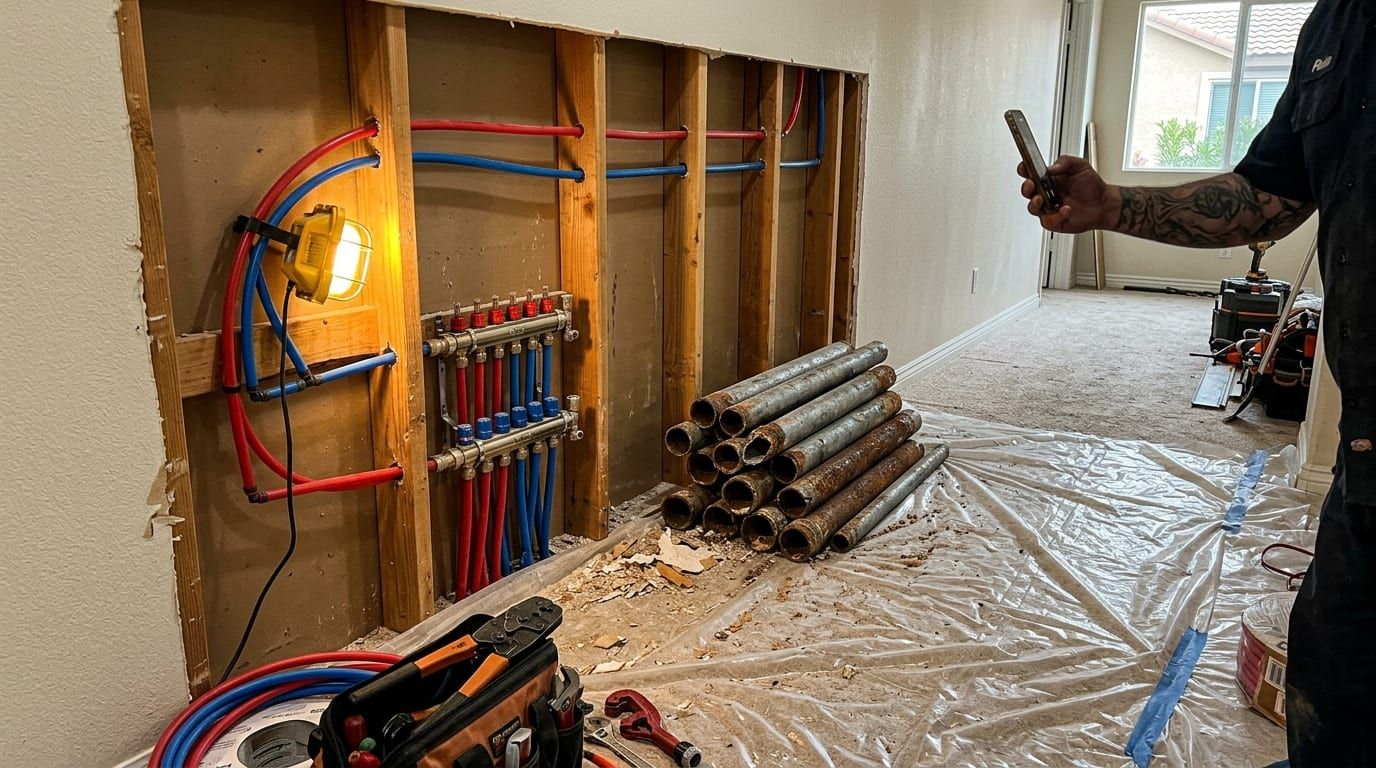
A second failure on the same run is the pipe reporting its condition rather than reporting an accident. The rest of that line is the same age, was installed the same way and sits in the same conditions. At that point rerouting the run — out of the slab, through walls or the attic — ends the sequence instead of postponing it.
What we do when we arrive
Confirm the water is off and the property is safe. Find the failure, which on a slab leak means isolating the hot and cold sides at the heater and then listening along the run rather than opening the floor on a guess. Explain what the options are, with the number, before anything is cut.
On a night call the first visit often ends with the system safe and stable rather than fully repaired, because the right permanent fix sometimes needs daylight, a part or a permit. A rushed midnight repair that fails again in a month helps nobody.
Finding the burst when there is nothing to see
A split behind plaster or under a slab is located by narrowing, not by guessing, and the order barely changes from house to house. The meter goes first: with everything inside shut, a dial that keeps creeping proves the loss is live. Then the hot and cold sides are isolated at the water heater and held under pressure separately, which halves the search in one move and, under a slab, usually points straight at the hot side. From there it is acoustic work, listening along the run through the floor, with a thermal scan across the slab to confirm where a hot line is warming the concrete above it.
The point of all of it is that the floor gets opened once, in the right place, rather than three times while somebody works it out. Anyone proposing to break concrete before the system has been isolated and listened to is asking you to pay for the search with your foundation.
What to open and what to leave shut once the water stops
The pipe is only half the damage. Building materials pull water sideways and upward long after the leak is stopped: drywall wicks it up from the bottom plate, the chipboard base of a sink cabinet swells and never fully recovers, and carpet underlay holds it flat against the slab where nothing can evaporate. Open cabinet doors and toe-kick spaces, lift the edge of the carpet rather than shampooing the top of it, and keep air moving through the room.
What to leave shut is the wall you have already opened. Closing a damp cavity back up because the room looks tidy again is the most common way a burst becomes a mould problem two months later. Wet framing needs to be dry to the touch and stay dry for days before anything goes over it.
A reroute or a repipe is permitted work
Replacing a failed section is maintenance. Rerouting a run out of the slab, or repiping a house, is permitted work through the Costa Mesa building department, or through Orange County if the property sits on unincorporated land such as North Tustin, Coto de Caza, Ladera Ranch, Rossmoor or Rancho Mission Viejo. The new pipework is inspected before it is closed up, which is the protection you want and also the reason its schedule is not the schedule of a night call.
So a first visit at midnight often ends with the house safe, the failed section isolated and water back on to the rest of the property, with the permanent work booked for a day when the inspection can happen. It also leaves a record attached to the address, which matters the next time anybody asks what is actually in the walls.
What actually drives the number
Two identical bursts in two houses on the same street rarely come to the same figure, and the pipe itself is the cheapest part of any of it. Access moves the number before anything else: a split in a reachable attic run is a different day’s work from the same split under a finished floor in the middle of a slab. Then comes the length that has to be replaced rather than patched, whether galvanised and copper have to be transitioned, whether concrete is opened and made good, whether the regulator or the water heater turns out to be implicated, and whether the work is permitted and inspected.
None of that can be answered down a phone line. An honest figure needs somebody standing in the house with the meter read, the pressure gauged and the failure actually located.