
Emergency plumbing
The leak you cannot see is the one that costs the most
Visible leaks get fixed. The expensive ones are the leaks nobody sees for months — under a slab, inside a wall cavity, or out in the yard between the meter and the house.
The ten-minute test that settles it
Turn off every tap, the washing machine, the dishwasher, the ice maker and the irrigation controller. Go to the water meter in the parkway and note the exact reading, including the small sweep hand. Do not use water for fifteen minutes. Read it again.
Any movement means water is escaping somewhere between the meter and your fixtures. That single observation turns a suspicion into a fact, and it costs nothing.
The signs, and what each one usually means
A warm patch on the floor
In a slab-on-grade house — most of Costa Mesa — a warm area of tile or concrete with nothing above it to explain the heat is a hot-water slab leak until proven otherwise. Hot-side copper fails far more often than cold, because heat and movement work on the same pipe.
The sound of water with nothing running
Late at night, with the house quiet, a continuous hiss or rush inside a wall or under the floor is exactly what it sounds like.
Damp at the edge of a carpet
Water under a slab wicks outward and appears at the perimeter of a room before it appears in the middle of it. A carpet edge that is dark and cool along one wall is worth investigating.
A musty smell in a cupboard
Under-sink cabinets tell the truth. Press the cabinet floor: if it is soft, water has been sitting there long enough to swell the board, which means weeks rather than days.
Staining along a line rather than in a patch
A stain that follows a straight line across a ceiling is tracking a pipe. A round patch is usually a one-off event, like an overflow upstairs.
Paint or skirting lifting for no reason
Timber and plaster absorb before they show. A skirting board that has begun to curl away from the wall has been wet for a while.
Where hidden leaks actually happen
What we do rather than opening the floor
Nobody should be cutting concrete to find out whether there is a leak. The sequence is isolation, then listening.
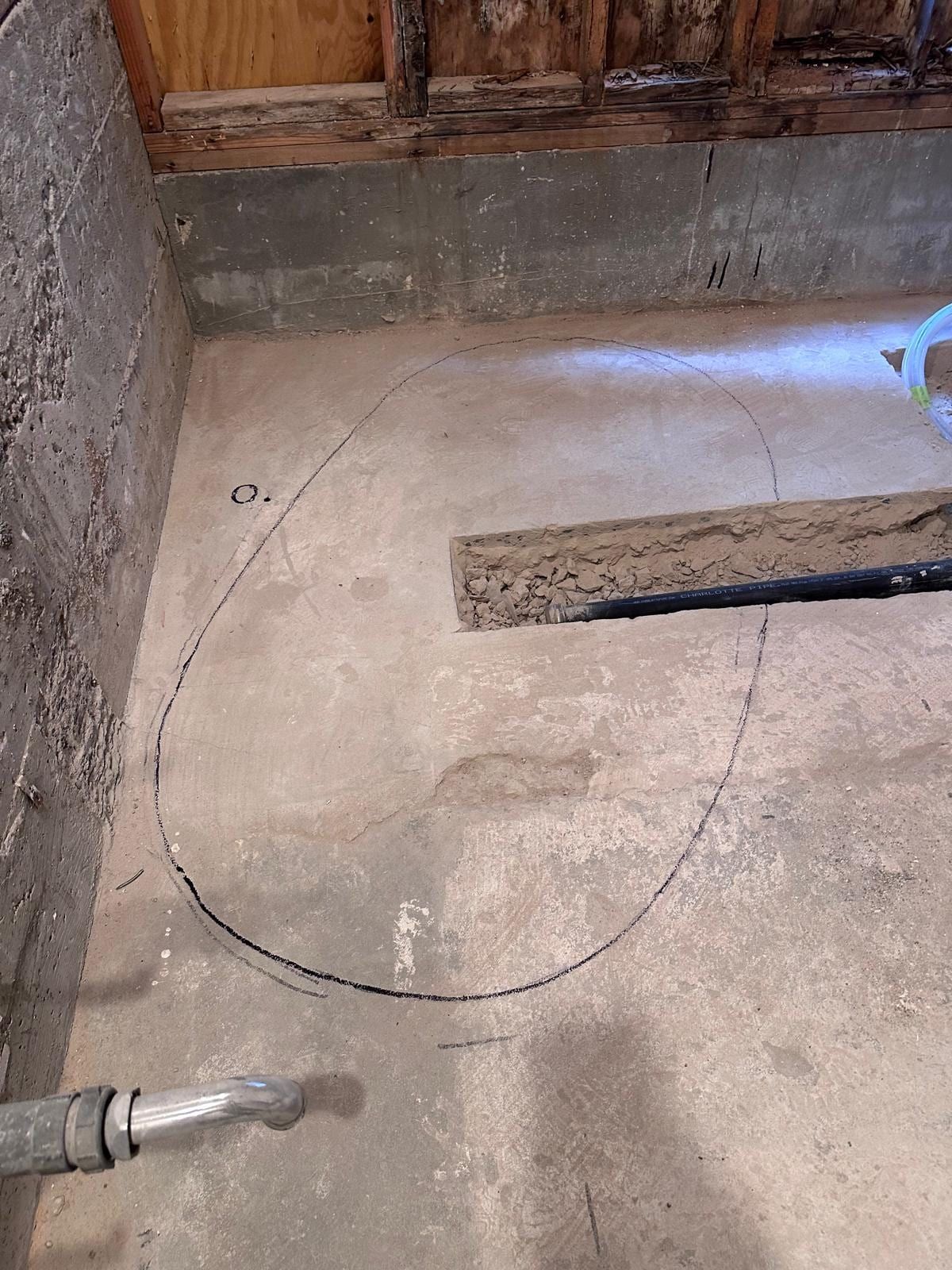
Isolating the hot side at the water heater says which side of the system is losing water. Isolating the house from the service line says whether the loss is inside or outside. Acoustic equipment then narrows the position along the run to a small area, and on the hot side a thermal check confirms it. Only then does anything get opened, and by that point the opening is a modest square rather than a room.
Repair it, or reroute the run?
A first slab leak in otherwise sound copper is usually worth a spot repair. The house is back to normal in a day and there is no reason to assume the rest of the run is about to follow.
A second failure on the same run is different. That pipe is the same age along its whole length, it was installed the same way, and it sits in the same conditions. Rerouting it above the slab ends the sequence; repairing it again simply schedules the next one.
What it costs to wait
Water under a slab does not stay under the slab. It saturates the ground, wicks into flooring and skirting, and eventually reaches drywall, where the problem stops being plumbing and becomes mould and carpentry. Every week of waiting adds to the part of the bill that has nothing to do with pipe.
The leaks the meter will never show you
The meter measures water arriving. A drain line loses water that has already been measured, so a failed waste pipe can soak the ground under a house for months with the dial perfectly still.
Telling the two apart takes no equipment. A supply leak is continuous, because the pipe is under pressure day and night. A drain leak only wets when something upstream is used, so the damp appears an hour after a shower and dries back.
In this housing stock that is ordinary rather than exotic. Costa Mesa houses from the 1960s and 70s were built with cast-iron waste under the slab, and anything older than about 1960 may still have clay out to the street. Both fail at the joints long before they ever block.
The pipe you own without knowing it
Past the house, the sewer lateral belongs to the property owner all the way to the Costa Mesa Sanitary District main, which usually runs under the middle of the street rather than at the kerb. A failure out there shows as sinking ground or a soft patch in the parkway, not as anything visible indoors.
CMSD runs a rebate for a camera inspection of the lateral, and for fitting a ground-level cleanout where a property has not got one. Both are worth taking up on an older house: the camera turns an assumption about the pipe into a recording of it, and a cleanout lets the next person work the line without lifting a toilet.
Nothing out there gets recommended before the line is filmed. The footage also settles method: cabling clears a channel through a blockage, jetting scours the wall back to bare material.
How old is the leak, and how to read it
The damage carries a rough timeline, worth reading before anything is opened.
On local groundwater the deposits are the clearest of those, because the mineral that scales a tank builds on a slab in proportion to time.