
Drains
Standpipe backing up during the spin cycle
A washing machine empties under pressure, so a laundry drain that is even slightly restricted will overflow long before a sink would. Lint and detergent, standpipe size, a blocked vent and the main line are the four places to look, roughly in that order.
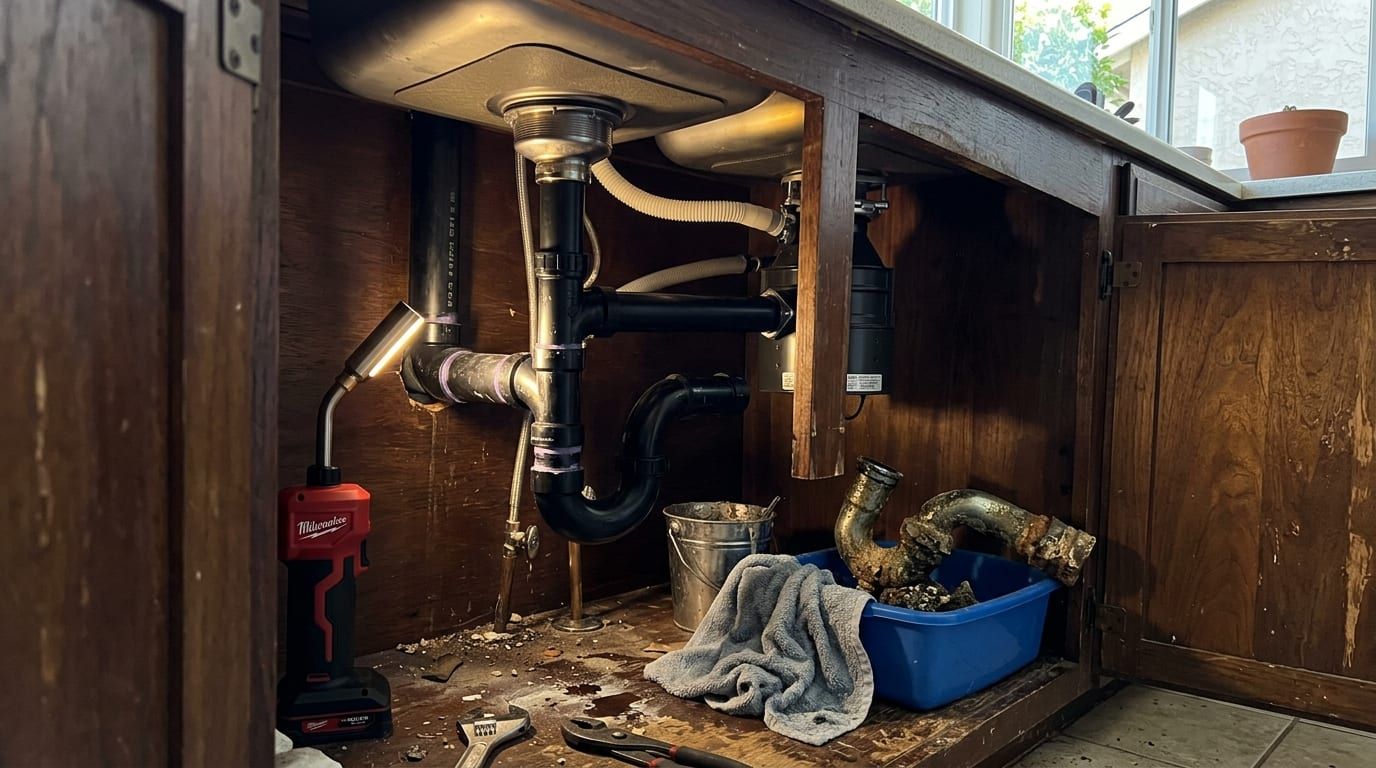
A laundry drain overflows because the washing machine empties faster than the drain can carry the water away. The pump moves a full tub in well under a minute and it does not care what is happening downstream. So the question is not why the washer is doing that, since it always does that, but what has narrowed the pipe. In rough order of likelihood: a lint and detergent build-up in the branch, a standpipe or trap that is undersized or plumbed at the wrong height, a blocked vent, or a main line blockage that happens to show itself here first.
The washer is a pump, and the drain is not
Every other fixture in the house drains by gravity. A sink empties as fast as gravity and its trap allow, which is slow. A washing machine has a motor-driven pump pushing water out through a hose, and a modern machine finishes its discharge in a hurry. A branch that carries a bathroom sink perfectly well can be nowhere near adequate for that burst. This is why the laundry is usually the first drain in a house to complain, and why it can overflow while every other fixture looks fine.
Lint and detergent build a particular kind of blockage
Take a laundry standpipe apart and the material inside is not what people expect. It is a grey felt: fibre shed from clothing, bound into undissolved detergent and the fats that wash out of fabric. Cold-water washing produces more of it, because detergent dissolves less completely and the greasy fraction never melts. Powdered detergent and fabric softener both add to it. The felt does not sit in one lump. It lines the pipe evenly, so the drain gets slower over years and then fails on one ordinary Tuesday.
Where in the pipe the felt actually collects
The standpipe itself is rarely the worst part. Gravity keeps the vertical section reasonably clear and the material settles where the pipe turns horizontal and the water slows down. In many houses here the laundry branch joins the kitchen line before either reaches the main, which means lint meets kitchen grease at a fitting, and the two together make a blockage neither would make alone. That is why clearing a kitchen sink sometimes fixes the laundry, and why the reverse happens as well.
The standpipe, the trap and the height
A laundry standpipe is the vertical pipe the washer hose goes into. Underneath it there is a P-trap, and the height between that trap and the top of the standpipe matters. Too short and the discharge overwhelms it and comes out of the top. Too tall and the pump labours to lift the water. The hose should sit loosely in the pipe with an air gap around it, never pushed down to the trap and never taped in, or the machine can siphon its own wash water back out mid-cycle.
Why the older narrow standpipe struggles
Costa Mesa has a median housing build year of 1972, with 68 per cent of the stock built before 1980. A lot of those laundry hook-ups were installed for machines that emptied far more gently than today’s do, and a fair number are a narrower standpipe than would go in now. Combine a narrow pipe with fifty years of lint felt and a modern pump, and the pipe overflows even though nothing in it is fully blocked. Replacing the standpipe and trap with a correctly sized assembly is often the actual fix.
When it is the vent, not the pipe
If the water level in the standpipe surges up and then glugs down while the pipe below it is clear, suspect the vent. Every trap needs air behind the water or the flow drags a vacuum and stalls. Vents run up through the roof and collect leaves, nests and, on older houses, corrosion at the connection. A vent problem often shows up as gurgling somewhere else at the same moment, and it is worth mentioning when you call, because it changes where the work starts and which access is needed.
Things to check before anyone comes out
The garage laundry on a slab
Slab-on-grade is the normal construction here, and the laundry hook-up is frequently in the garage against a shared wall. Overflow water on a slab does not stay where it lands. It runs to the low corner, under the bottom plate of the framing, and into whatever is stored on the floor. If the machine has overflowed more than once, look at the drywall along the base of that wall before deciding it was harmless. Damp gypsum wicks upward and takes weeks to declare itself.
When the laundry drain is only the messenger
Because the washer sends the largest single slug of water in the house, a partly blocked main line often reveals itself at the laundry first. The tell is other fixtures reacting: a toilet bubbling, a shower pan filling, a kitchen sink slowing in the same period. If that is happening, the standpipe is not the problem and cleaning it will change nothing. The signs that separate a main line blockage from a local one are set out in a separate article on this site.
Cleaning it, and what cleaning cannot fix
A laundry branch lined with lint and soap responds well to being scoured rather than bored. Running a cable through it opens a passage in the felt, water flows for a while, and the felt closes back in because the walls were never touched. High pressure water takes the wall back to the material the pipe is made of. On older cast iron there is a limit to what that recovers, because corrosion has already taken some of the inside diameter permanently, and the honest answer in that case is a new section of pipe rather than a cleaning every year.
One practical habit: fit a mesh lint trap on the end of the discharge hose and change it when it loads up. It catches a surprising amount of what would otherwise become the felt, and it takes a few seconds to inspect.