
Drains
Why the lowest drain in the house floods first
Water rising out of a floor drain means the blockage sits downstream of everything else in the building. This explains what the overflow tells you, why yard drains are a separate system entirely, and what to stop doing while you wait.
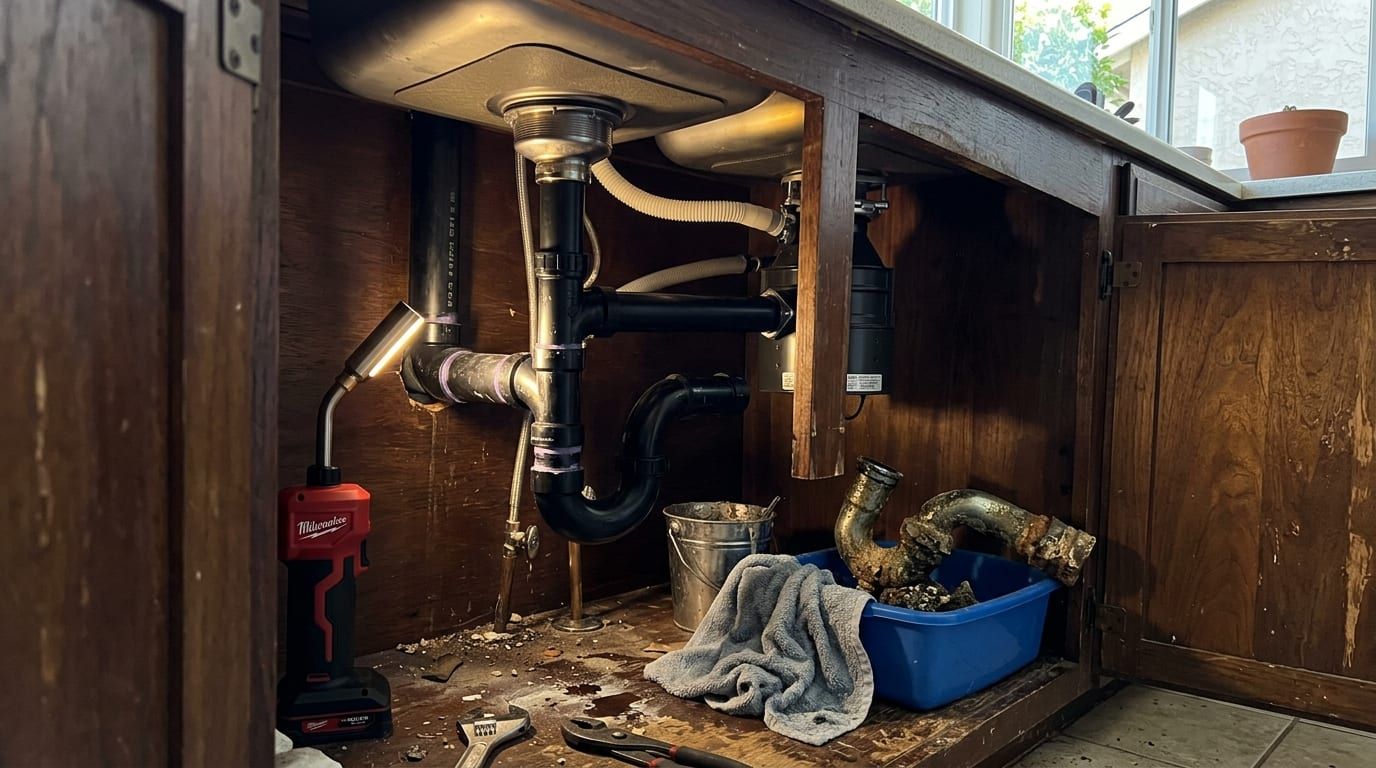
A floor drain is the lowest opening in the drainage system, which is what makes it useful and what makes it alarming. When water comes up out of one, it is not because that drain is blocked. It is because everything downstream of it is blocked, and the waste is finding the first opening it can reach, which is the one nearest the floor. In a Costa Mesa house that is usually a garage or laundry drain rather than a basement one, because houses here sit on a slab.
Basements are rare here, floor drains are not
Almost every house in Costa Mesa is slab-on-grade. The city’s housing stock has a median build year of 1972 and 68 per cent of it predates 1980, and through all of that period the standard was a concrete slab poured on the ground with drainage cast into it. So the floor drain that overflows is rarely at the bottom of a stair. It is at the low point of a garage slab, beside a laundry hookup, under a water heater in a hall closet, or in the utility room of a condominium building.
Older commercial buildings have proper floor drains too, often with a grease interceptor between them and the sewer. They behave the same way, with more at stake when they overflow.
Why the lowest opening floods first
Waste from every fixture in the building joins one line and leaves through one lateral. Block that lateral and water backs up behind the obstruction, filling the pipe from the blockage towards the house. It keeps rising until it reaches an opening. Toilets sit a few inches off the floor, shower drains a little lower, and the floor drain lower still, so the floor drain overflows first, sometimes with waste from a bathroom at the far end of the building.
That is the diagnostic value of the thing. A single blocked fixture backs up in itself. A floor drain that overflows when somebody flushes a toilet or starts a wash cycle is evidence that the fault sits downstream of the whole system.
Read what comes up
The drains that never touch the sewer
Area drains, driveway trench drains, deck drains and downpipe leaders are a completely separate system. They discharge to the kerb or a storm drain, not to the Sanitary District’s sewer, and they are usually four inch pipe carrying a lot of silt, roots and leaf litter. If the flooding happens only in rain, the water is clean, and the drain sits outside or at the edge of a driveway, that is a landscape drainage job.
The distinction matters because the tools and the plan are different. Clearing a silted yard drain is straightforward work. The same nozzle in a sewer lateral is a different pressure, a different head and a different set of consequences if the pipe is in poor condition.
Stop adding water
What happens when somebody arrives
Access decides the first ten minutes. A ground-level cleanout on the lateral lets a camera and a jetting hose go straight into the line in the right direction. Without one, the alternatives are the roof vent or pulling a toilet, both slower and both at a worse angle. Finding or fitting a cleanout is a subject in its own right, and there is a separate article on where to look for yours.
Then the line gets filmed before anything is recommended, with footage markers so the distance to the problem is known rather than estimated. Distance matters more here than in most places, because under Costa Mesa Sanitary District rules the homeowner owns the lateral all the way to the point of connection with the district main, and the main is usually under the middle of the street. A blockage out past the kerb is still on your side of the line.
What the camera finds decides the tool. A lump gets cabled. A lining gets jetted, because a cable through a coated pipe leaves the coating exactly where it was; the article on drains that keep clogging goes into why the same drain backs up three weeks after a snaking. A collapsed or offset section gets located and dug. A low section that holds water gets called what it is, rather than being cleaned again every few months and described as fixed.
The dry floor drain and the smell that follows
A floor drain has a trap under it like any other fixture, and a garage floor drain can go months without seeing water. When that trap dries out the drain stops being a drain and becomes an open pipe into the sewer system, which is why a garage sometimes smells of sewage in high summer with nothing actually wrong. Some floor drains have a trap primer, a small line that feeds them a little water whenever a nearby fixture runs. Many have nothing of the sort.
If yours has none, a jug of water down it once a month settles the question. The article on shower drain odours covers the same mechanism inside a bathroom.
After it is clear
Ask what the line looked like after the work, not only before. A lateral that has been cleared and filmed gives you a known starting point: the pipe material, the distance to the connection, whether roots are entering at a joint, whether there is a low section holding water. That is the information that decides whether the next event is a routine clean or a repair, and it is far easier to gather with the line open than with a garage floor under two inches of water.