
Drains
What a cable does, what a jetter does, and when each is wrong
These are not two grades of the same service. One bores an opening through an obstruction and one washes the pipe back to bare material, and there are lines where the second should never be attempted at all.
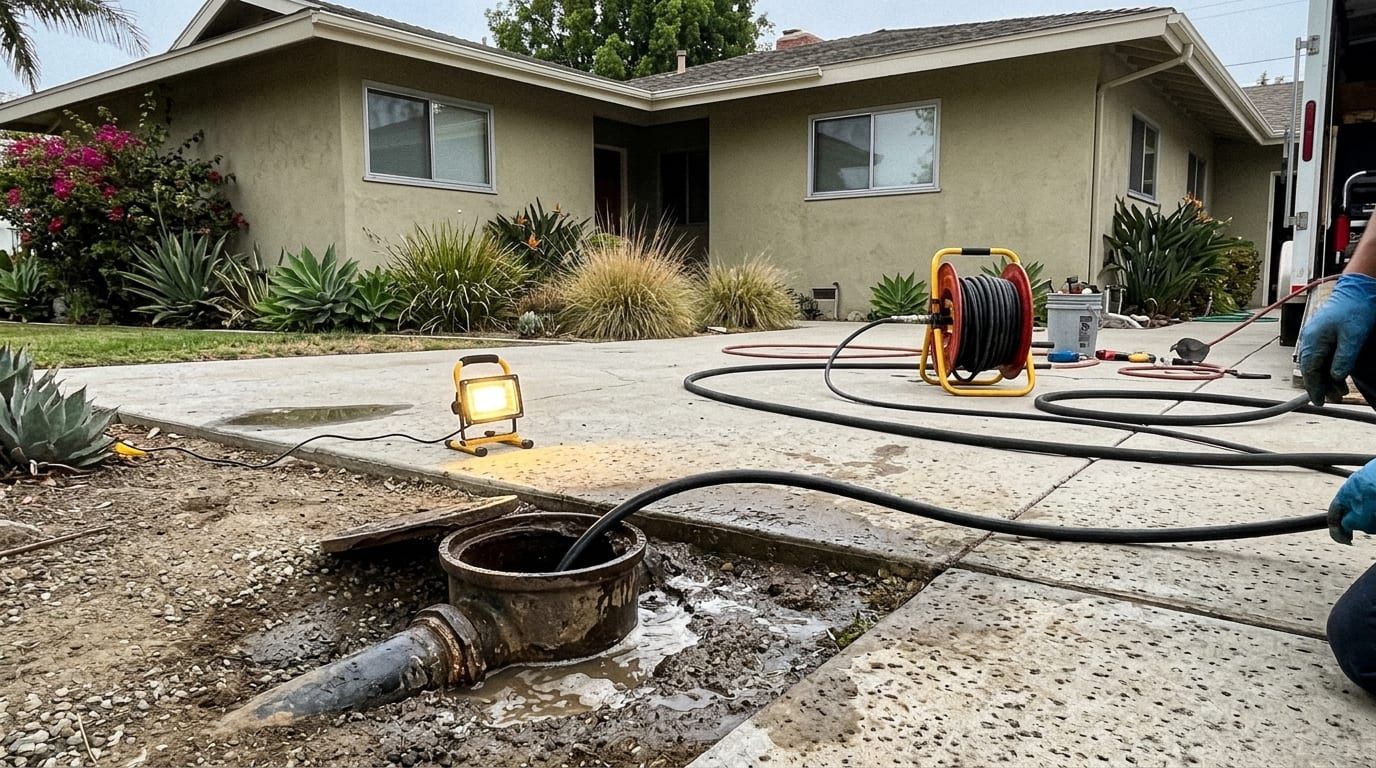
A cable machine sends steel down the pipe with a cutting head on the end and bores an opening through whatever is in the way. A jetter sends a hose with a nozzle that fires water backwards at high pressure, which drives the hose upstream and scours the pipe wall as it travels, flushing everything back down to the access point. If a drain has never blocked before, the cable is usually the right and smaller job. If it blocks on a schedule, the cable has been treating a symptom. And on some lines the jetter is the wrong tool entirely, which is why the camera goes in before either one.
What the cable is really doing
The head on the end of the cable is a specific diameter, and the opening it leaves behind is roughly that diameter. In a line packed with grease and soap, that opening restores flow immediately and convincingly. Water runs, the sink empties, everyone is satisfied. What has not changed is the material still coating the pipe either side of the new channel, which begins closing the opening again from the moment the water starts flowing past it. On a root mass, a cutting head shears the growth off flush with the pipe wall, which is genuinely useful, but the rootlets left in the joint are the part that grows back.
What the jetter is really doing
The nozzle carries several rear-facing jets and sometimes a forward one. The rear jets provide the thrust that pulls the hose up the line and, at the same time, strike the pipe wall at an angle that lifts material off it. The debris travels back down with the water to the cleanout, which means the process needs somewhere for that water to go. On cast iron carrying decades of build-up, a properly jetted section comes back on camera looking like bare metal, with the original bore restored rather than a channel through the middle of it. That is the whole difference, and it is visible on a screen rather than something you have to take on trust.
Why the same drain blocks again three weeks after it was cabled
This is the question that brings most people to the subject, and the answer is usually that the obstruction was never a lump. On fifty-year-old cast iron the blockage is a lining. The bore has narrowed along its whole length, and somewhere along it the remaining gap finally closed. A cable punches through the closed part, flow returns, and the lining either side is untouched, so the same gap closes again in weeks. Costa Mesa’s median build year is 1972 and 68 per cent of the housing stock went up before 1980, which puts an enormous number of local kitchen and main lines in exactly that condition. If a line was cabled and shut again inside a month or two, the useful next step is looking at the pipe rather than buying the same service a second time.
When jetting is the wrong call
Roots need a different plan from grease
Roots do not come through the wall of a sound pipe. They come in at joints, which is why they turn up in clay laterals from before 1960 and at the connections of older cast iron. A cutting head or a root nozzle takes them back to the pipe wall and restores full flow, and the line will genuinely run properly afterwards. It is also honest to say out loud that they will return, because the joint that let them in is still open. Cutting roots is maintenance on a known problem, and it is a perfectly reasonable thing to choose deliberately. What it is not is a repair, and anyone presenting it as one is not being straight with you.
Filming before and after is the whole argument
The camera before the work tells you two things: what is in the pipe, and whether the pipe can take what you are about to do to it. The camera after tells you what was actually achieved. Without the second pass, a cleaning is an invoice and a claim. With it, you can see whether the wall came back to material or whether a channel was bored through a lining and called finished. Ask to watch the screen live, ask for the footage, and keep it, because next time the comparison is worth more than any description either of us could write down.
Access decides more than the method does
A ground-level cleanout outside the house turns every future drain visit into a driveway job. Without one, the way in is a roof vent or a pulled toilet, which adds time to every single call for the life of the house. In Costa Mesa the sewer lateral belongs to the homeowner all the way to its connection with the district main, typically under the middle of the street, so the access on your side of that point is worth having. The Costa Mesa Sanitary District runs a rebate programme covering either a CCTV video inspection of the lateral or the installation of a ground-level cleanout. The amounts and the conditions are the district’s to publish, not ours to quote, so read their own page. The point is that the programme exists and most people do not know it.
Matching the method to the symptom
Three questions are worth asking before agreeing to jetting on any line: was the line filmed first and can you see that footage, what material is the pipe and what condition is it in, and where does the water and debris exit. Anyone who can answer all three has looked. Anyone who cannot is guessing at your expense, and on a rotted line the guess is expensive.