
Drains
What a blocked drain is telling you about the house
A blocked drain is a symptom, and the useful work is deciding what it is a symptom of. Housing age, which fixtures are affected and where the cleanout sits will tell you most of that before a single tool comes off the van.
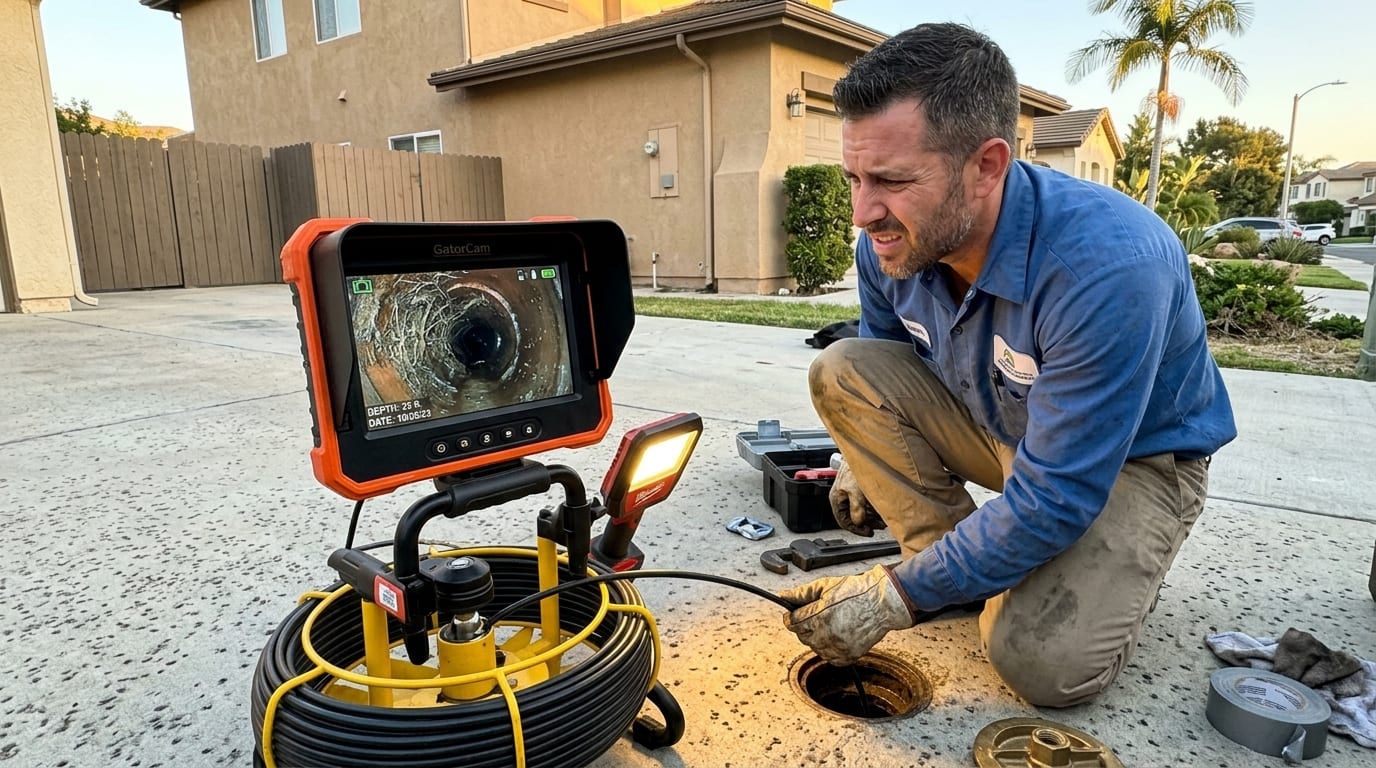
Snaking is the right first move when a single fixture is slow and the rest of the house drains normally. Jetting is the right move when a line has been cleared before and blocked again, when the pipe wall itself is coated, or when roots have found a joint. Nobody can honestly pick between the two from the doorway. A camera down the line settles it in about ten minutes, and on a house built in the early 1970s, which describes most of Costa Mesa, the screen usually shows something that changes the plan.
The age of the house narrows it down before the van arrives
Costa Mesa has 44,427 housing units, a median build year of 1972, and 68 per cent of the stock finished before 1980. That single number tells a plumber a great deal before anyone lifts a cap. A house from that era almost certainly has cast iron waste pipe under it and copper supply above. Cast iron rarely fails by cracking in half; it fails slowly, from the inside, as the bore scales up until the working diameter is a fraction of what the pipe size suggests. A house from before 1960 is a different animal again: galvanised steel supply, cast iron waste, and a clay lateral running out to the street with a joint every few feet for roots to find.
Elsewhere in the county the same reasoning applies with different dates. Rossmoor sits at a median build year of 1958, Seal Beach 1966, Garden Grove 1965, Santa Ana 1969, Huntington Beach 1974. That is cast iron and clay country. Irvine’s median is 2002 and Ladera Ranch 2005, which means ABS waste and PEX supply, and a blocked drain there is far more often about what went down it last week than about the condition of the pipe. Rancho Mission Viejo, median 2015, is newer still. The address changes the first question worth asking.
Which fixture backs up tells you how far down the trouble is
The pattern of what is affected narrows the location down further, and you can work through this part yourself before you phone anybody.
In Costa Mesa the lateral is yours out to the middle of the street
The Costa Mesa Sanitary District maintains the sewer main. The homeowner owns the lateral, meaning the pipe from the house all the way to the point of connection with that main, and that connection is usually under the middle of the street rather than at the property line. It stops being a technicality the moment a camera finds the blockage sixty feet out and under the tarmac, because the repair, the permit and the traffic control all sit with the property. Knowing where your responsibility ends is worth ten minutes of reading before you ever need it.
What the first fifteen minutes of a drain call look like
We ask what backed up, when, and whether it has happened before, then we go looking for a cleanout. If there is one at ground level outside, that is where the work starts. If there is not, the way in is a roof vent or a pulled toilet, both slower and messier, and we say so rather than pretend the job is smaller than it is. Once the line passes water we put a camera down it and you watch the screen with us. That order matters. Clearing a line and stopping there tells you it is open today. Clearing it and then looking tells you why it closed and whether it will close again, which is the only question worth paying to answer.
Which of these can wait until morning
The phone is answered by a person 24 hours a day, and part of that job is telling people they do not need anyone tonight.
Snake, jet, or stop and think
There is a third answer that gets skipped. Sometimes the camera shows a break, a section that has dropped out of line, or a length of cast iron with the bottom rotted away, and no amount of cleaning changes any of that. Clearing it restores flow for a while, which is worth doing tonight, but the actual fix is a repair. The reverse is just as common: a line that looks alarming on screen but is simply carrying grease over sound pipe, where one cleaning is the whole job and nothing else needs selling. That second outcome comes up as often as the first. For the mechanical detail of how a cable and a jetter differ, that has an article of its own; the short version is that a cable makes a hole through a blockage and a jetter takes the pipe wall back to bare material.
Worth writing down before you call
Five lines on the back of an envelope change what happens in your driveway. Someone who arrives knowing the line was cleared eight months ago and has closed again is looking for a reason rather than just a blockage. The licence behind that work is C-36, CSLB #1131308, and the state register will confirm it in under a minute. We cover Orange County only, from Newport Beach at under two miles out to San Clemente at twenty-three, and when the drive is long we say so instead of guessing at an arrival time.