
Water heaters
What a heat pump water heater needs from your house
The answer turns less on the appliance than on the room it goes in. A heat pump water heater in an attached garage is usually a straightforward swap. The same unit in an interior hallway closet turns into three other jobs first.
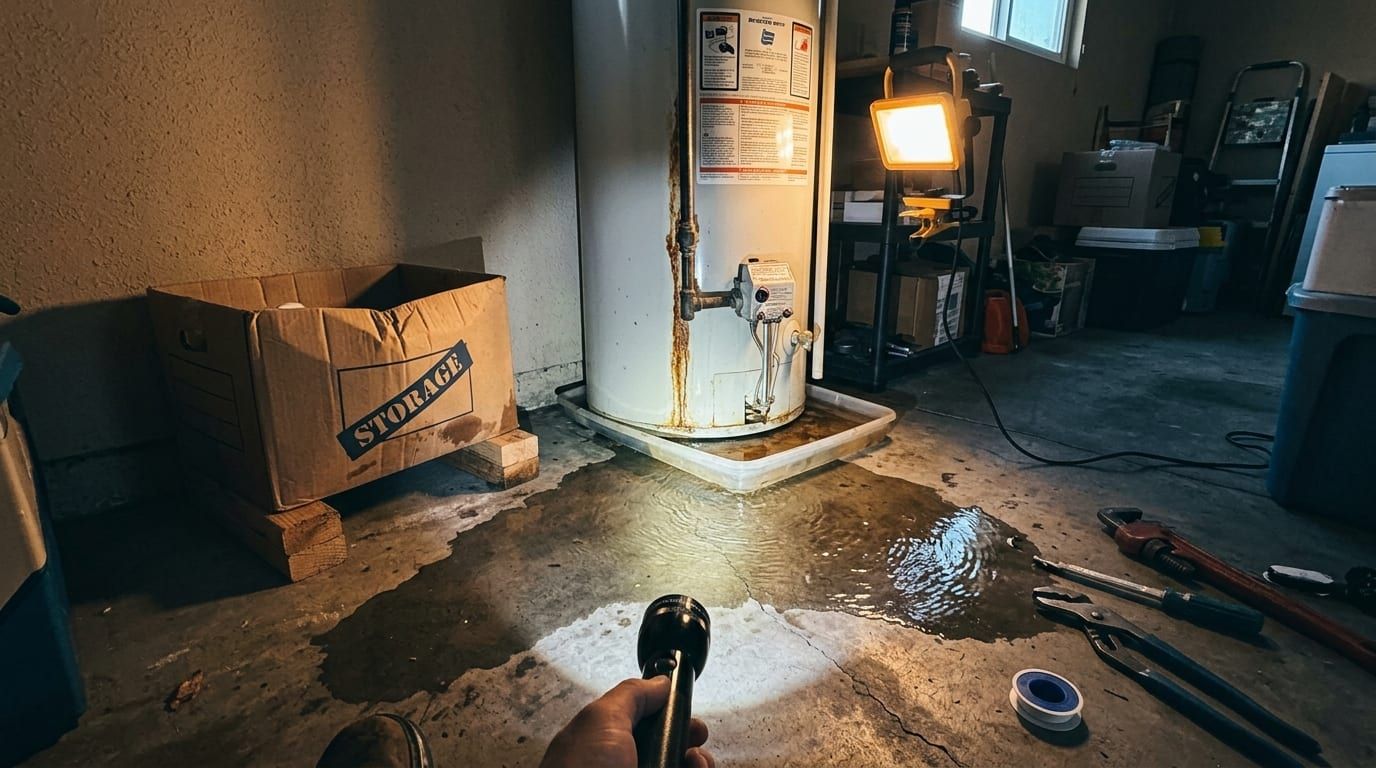
For most Costa Mesa houses with the water heater in an attached garage, yes, it is a reasonable choice. For a heater in an interior closet or a condo utility cupboard, usually not without a lot of other work. A heat pump water heater does not burn anything. It takes heat out of the air around it and moves that heat into the water, which means it needs a certain volume of air to draw from, a way to drain the condensate it produces, and a 240-volt circuit that a gas heater never had. Those three requirements decide the answer far more than the machine itself does.
What the machine is doing in there
Run a refrigerator backwards and you have the idea. A compressor, a fan and a coil sit on top of an ordinary storage tank. The fan pulls room air across the coil, the refrigerant picks up heat from that air, and the compressor concentrates it and hands it to the water in the tank. Because it is moving heat that already exists rather than making heat from fuel, it puts far more energy into the water than it draws from the panel. That is the whole appeal, and it is real.
The side effects follow from the same physics. The air leaving the unit is cooler and drier than the air going in, which is either a benefit or a nuisance depending on the room. The coil pulls moisture out of that air, so the unit produces condensate the way an air conditioner does and needs somewhere to put it. And the compressor runs, audibly, for long stretches rather than in short bursts. Most units also carry conventional resistance elements as a backup, and can be set to lean on them, which restores the fast recovery and quietly discards the reason you bought the thing.
What the house has to provide
A 1972 garage in Costa Mesa is the easy case
The median Costa Mesa home was built in 1972, and 68 per cent of the city’s 44,427 housing units went up before 1980. Thirty-nine per cent are detached single-family houses, mostly slab-on-grade, and in that era the water heater almost always ended up in the attached garage, often in a corner near the panel. That room is close to ideal. It has the air volume without any ducting. It has a concrete floor that tolerates a condensate line running to a wall penetration or a floor drain. The electrical panel is frequently on the same wall or the one behind it, which keeps a new 240-volt circuit short and out of finished drywall.
The climate helps too. Costa Mesa sits less than two miles from the Newport Beach coastline, and an attached garage here does not get cold in the way a garage in an inland winter climate does. The air the unit draws from stays in a range where it works efficiently for most of the year instead of dropping onto its backup elements every January morning. Cooler garage air in August is a minor bonus, not a reason to do it.
The hallway closet is the hard case
Move the same appliance to an interior closet in a townhouse or condo and every requirement above turns into a project. The closet fails the air volume specification, so you need louvred doors that satisfy the manufacturer or a ducting kit that takes up the space the tank needs. The cooler exhaust air has to go somewhere, and dumping it into a hallway in winter is a complaint waiting to happen. There is no gravity drain, so you are adding a condensate pump. The compressor sits against a bedroom or living room wall. And the 240-volt circuit now has to be fished through finished construction. Every one of those is solvable. Together they change what the job is.
What changes about the hot water itself
In heat pump mode, recovery is slower than a gas burner. The unit heats gently over a long period rather than reheating a drained tank quickly. For a household that showers in a staggered way, that difference never surfaces. For a household with three showers back to back before school, it can. The usual answer is capacity rather than mode: a larger tank so there is more heated water banked before the demand starts, instead of setting the unit to lean on its resistance elements, which is the same as running an ordinary electric heater with a fan on top of it. Worth deciding that before the unit is ordered, not after.
The install details that do not change
None of the code requirements go away because the heat source changed. A compliant install still means two seismic straps anchored to structure, a drip pan with a drain line, a full-size T&P relief line ending near the floor with no valve in it, and an expansion tank where the system requires one. Two things are specific to the swap. If the old gas heater shared a flue with a furnace, removing the heater changes what that flue is carrying and how it was sized, and that has to be addressed rather than left. And water heater replacement is permitted work: through the city building department in Costa Mesa, or through Orange County on unincorporated land such as North Tustin, Rossmoor, Ladera Ranch, Coto de Caza or Rancho Mission Viejo.
Scale does not care how the water gets hot
Mesa Water District draws its supply entirely from local groundwater, nine wells into the Orange County basin, and groundwater carries mineral. A heat pump water heater has an ordinary steel storage tank underneath the clever part, and mineral settles on the floor of that tank exactly as it does in a gas heater. It still wants an annual flush, the anode rod still does the job it always did, and neglecting either shortens the life of an appliance that cost more to put in than the one it replaced. Our separate guide to flushing a tank covers the procedure.
How to decide before anyone gives you a number
If those answers put the unit in a garage with the panel nearby and a wall to drain through, it is a strong candidate and the install is close to a straight swap. If they force a ducting kit, a condensate pump and a long circuit through finished walls, then a gas replacement or a conventional tank is often the more honest recommendation, and it is the one we will make. Either way, the measurement comes before the recommendation.