
Water heaters
What groundwater minerals do inside your tank
Costa Mesa’s water comes out of nine wells rather than a distant reservoir, and groundwater carries mineral. This is where that mineral ends up, what it does to a storage tank and to a tankless heat exchanger, and which of the usual remedies are worth the trouble.
Where the water here comes from
Mesa Water District supplies most of Costa Mesa entirely from local groundwater, drawn by nine wells into the Orange County basin across an eighteen square mile service area that also takes in part of Newport Beach and some unincorporated county land, including John Wayne Airport. The deep well water arrives with an amber colour from ancient decomposed redwood in the aquifer, and that colour is removed at the Mesa Water Reliability Facility before the water reaches a house. Treatment for colour is not treatment for mineral. Dissolved calcium and magnesium stay in the water, and heating that water is exactly the thing that makes them come out of solution.
No hardness figure appears on this page, because the honest way to state one is from a test at your own tap, and Mesa Water publishes its own quality data for the system. What can be said without a number is that every water heater in this city is working in mineral-bearing water, and that the failure patterns here are the failure patterns of scale.
What actually happens when hot water meets mineral
Calcium carbonate is more soluble in cold water than in hot. Push water past a burner or an element and the dissolved mineral precipitates out as a hard, chalky solid. In a storage tank it falls to the bottom. On any surface that is hotter than the water around it, which means the element sheath and the exchanger wall, it bonds instead. Both outcomes are bad, but they are bad in different ways, and they show up as different symptoms.
Inside a storage tank
Sediment builds as a layer across the bottom of a gas tank, sitting directly between the burner flame and the water it is meant to heat. The burner now heats the sediment first. Water trapped underneath flashes to steam and forces its way up through the bed, which is the rumbling and popping you hear from an older heater in the garage. That noise is not cosmetic; it is a report on how much material is down there.
Three things follow. The tank holds less usable water, because the sediment occupies volume. The burner runs longer for the same result, because it is heating through an insulating layer. And the steel at the bottom runs hotter than it was designed to, which stresses the glass lining and accelerates the corrosion the anode rod is there to hold back. On an electric heater the mineral instead cakes onto the lower element, which then overheats and burns out early.
Inside a tankless heat exchanger
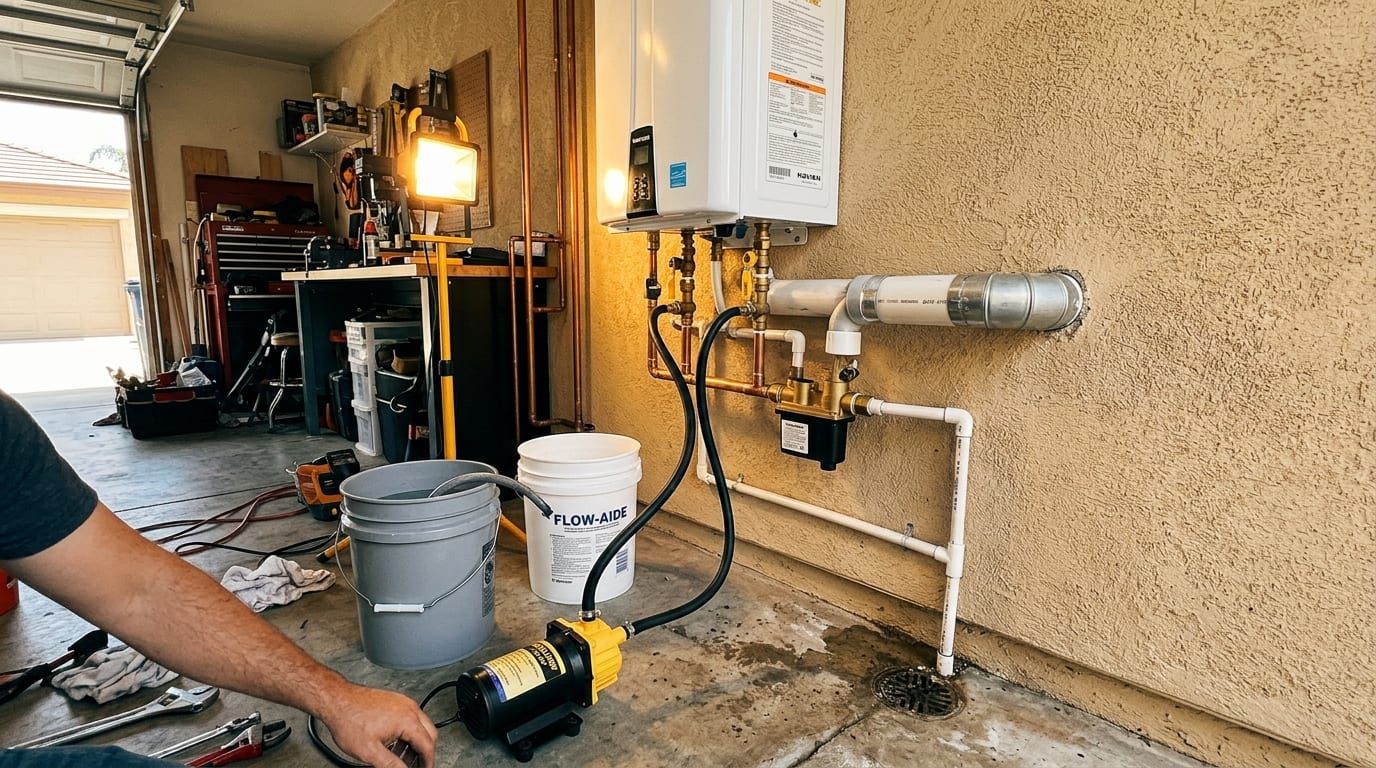
A tankless has no bottom for sediment to fall into. Water moves fast through narrow passages, and scale forms as a film on the exchanger wall, in the one place that matters most. The unit responds by firing longer and hotter to reach its set temperature, which encourages more scale, which is the loop that turns a good appliance into a service call. Symptoms arrive as flow and temperature faults, an outlet temperature that swings during a shower, or an error code that reads like an electronics problem and is really a chemistry problem.
This is why isolation valves matter on a tankless installed in Costa Mesa. With them, a descale is a routine visit. Without them, the same work means cutting into the pipework, and it tends to get deferred until the unit is already struggling.
Signs your heater is already scaled
Flushing: what it does and what it does not
Draining a few gallons through the bottom valve once a year, while the heater is still reasonably young, keeps loose sediment moving out before it consolidates. That is genuinely useful and takes twenty minutes. What flushing will not do is reverse a bed that has already hardened into a crust, and on a heater that has never been drained the attempt can go badly: the valve is often a plastic one, it clogs with the debris it dislodges, and it may not seat again afterwards.
So the honest rule is that flushing is maintenance, not rescue. If the heater is old and has never been touched, filming the symptoms and deciding on replacement is more sensible than fighting a drain valve. We would rather say that up front than sell an hour of work that cannot achieve what you are hoping for.
Softeners, conditioners and what each one changes
A softener exchanges hardness minerals for sodium and genuinely stops scale forming. It needs a drain, a power outlet, space near where the water enters the house, and regular salt. In an older Costa Mesa house the constraint is usually location: slab-on-grade construction, no basement, and a main that enters at an awkward corner of the garage.
Scale conditioners that use a template medium or a magnetic field do not remove hardness. The claim is that they alter how crystals form so they are less likely to bond to a surface. Results vary widely and independent evidence is mixed, so treat them as a possible improvement rather than a substitute for a softener. A whole-house sediment filter does something else again: it catches particles, not dissolved mineral, and will not stop scale on its own.
The rest of the house is paying too
The heater is where scale is loudest, but it is not the only place. Mixing cartridges stiffen and start to weep. Shower heads block. Dishwasher and washing machine valves collect the same deposit. Glass shower doors get the film that will not come off. If you are already considering treatment for the heater’s sake, count those as part of the same decision rather than separate annoyances.
One last connection worth making. Scale sets the pace at which a tank loses efficiency, but corrosion is what finally puts a hole in it, and that is the job of the sacrificial anode rod. There is a separate article on this site about how to check yours, and in this water it is the single cheapest thing you can do to extend the life of a tank you already own.