
Water heaters
Which water heater suits a 1970s Costa Mesa house
The appliance is chosen by the building, not by the brochure. Here is what actually separates a storage heater from a tankless in an Orange County house, and the four conditions that have to be true before a tankless is the better buy.
The short answer for a house like this
For most Costa Mesa houses, replacing a storage tank with another storage tank is the right call. A tankless is the better appliance under a specific set of conditions rather than as a general upgrade. Those conditions are: the gas supply can feed it, there is a clean path for sealed venting, the household genuinely runs long or overlapping hot water draws, and somebody is going to descale it on a schedule. Where all four hold, a tankless is excellent and will outlast a tank. Where two are missing, it is an expensive way to get the same shower.
That is not an argument against tankless. It is an argument for looking at the building before looking at the model numbers.
What the two are actually doing
A storage heater
A storage heater keeps a tankful of water hot around the clock and refills as you draw it down. Its limit is volume. When the hot is gone you wait for recovery, and recovery is slow relative to how fast a family can empty it. Its virtue is that it does not care about flow rate. A trickle at one tap and three fixtures running at once feel the same to it, because the heat is already banked.
A tankless heater
A tankless banks nothing. It senses flow, fires, and heats water as it passes through a heat exchanger. Its limit is not volume but rate: it can run all afternoon, but only at the flow it is sized for, and that flow is shared across every open fixture. Two showers plus a dishwasher will ask more of it than one shower does. It also has a minimum flow before it fires, so a barely-open tap can stay cold, and on short intermittent draws you can get a slug of cool water between hot ones.
Six things that decide it in your house
What the local water does to each
Mesa Water District draws Costa Mesa’s supply from local groundwater, and groundwater brings mineral with it. The two appliances handle that mineral in completely different ways.
A storage tank has somewhere to put it. Mineral drops out of suspension and settles on the bottom as sediment, where the gas burner then has to heat through it. That is what makes an older heater rumble and pop, and it is why the drain valve on a tired tank produces a dribble of grey grit instead of a clean stream. A tankless has nowhere to put it. The channels are narrow, the exchanger wall is thin on purpose, and scale forms directly on the surface that is meant to transfer heat. That is why isolation valves for a descale are not an accessory here, and why a unit that is never serviced starts throwing flow and temperature faults. There is a separate article on this site about what hard water does inside a heater, and it is worth reading before you commit either way.
What a legal replacement includes, whichever you pick
A quote that is much cheaper than the others is usually cheaper because it leaves things out. A code-compliant install has parts that are not optional.
All of it is permitted work through the city building department, or through Orange County on unincorporated land. The permit article on this site covers that side in more detail.
Where these things live in a 1972 tract house
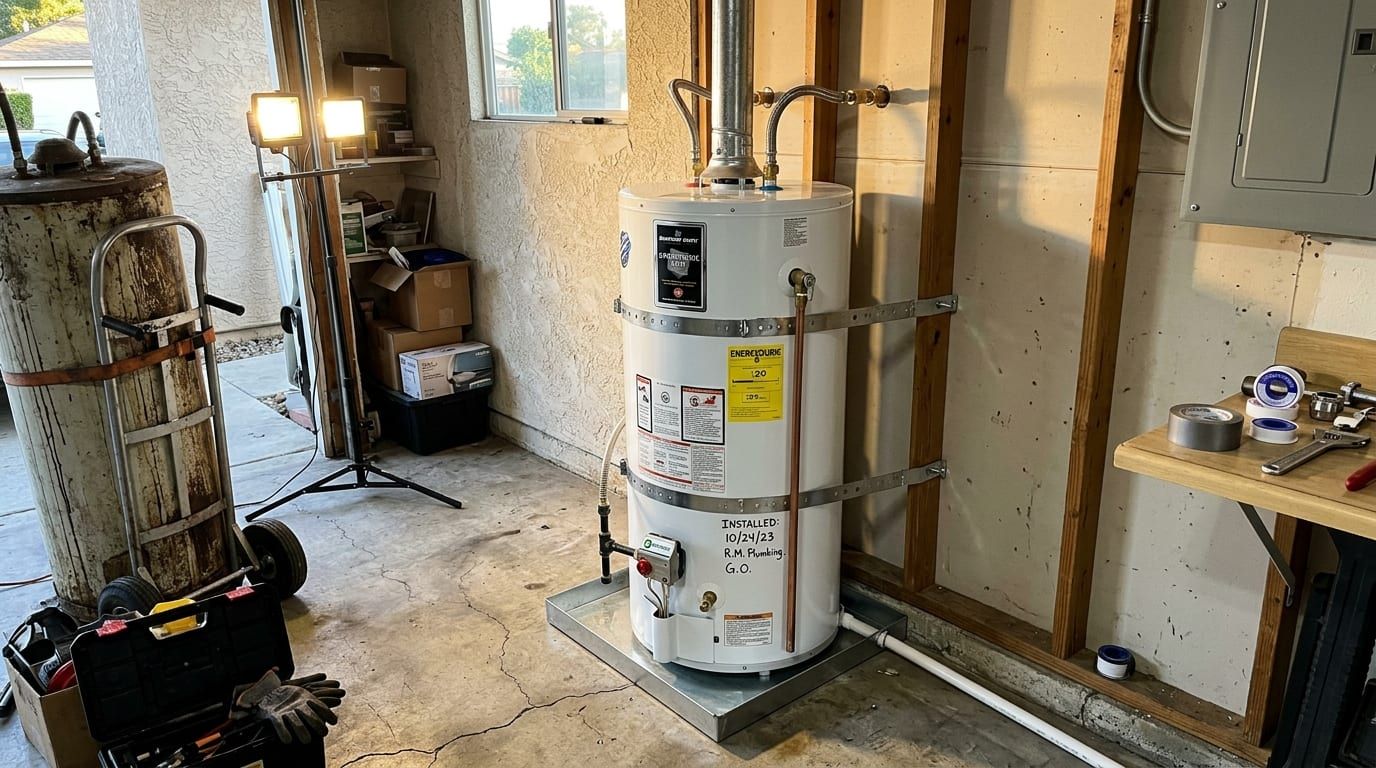
Costa Mesa’s median build year is 1972 and 39 per cent of its housing is detached single-family, most of it slab-on-grade. There is no basement to hide an appliance in, so heaters end up in garages, in hallway closets, or in exterior alcoves off a side yard. Each location changes the answer. A garage wall gives you clearance, a place for condensate and somewhere to run a pan drain. A closet gives you a tight box with a drywall ceiling and a vent that goes straight up through the roof, which is the situation where converting to tankless stops being a swap and starts being a remodel.
Exterior alcoves are the pleasant surprise. A wall-hung tankless outside frees interior space and makes venting trivial, and it is the one case where the conversion often costs less than people expect.
How to settle it in an afternoon
Count the gas appliances and look at the size of the line feeding the current heater. Trace, with your eyes, where a sealed vent could exit the wall. Watch how the house actually uses hot water for a week rather than how you imagine it does. Then open the drain valve on the existing heater and look at what comes out, because that tells you what the last decade of local water has been doing and what the next decade will do to whatever you install.
If those four checks all point the same direction, the decision is already made. If they contradict each other, the tank is the safer answer, and there is no shame in the smaller job being the right one.