
Sewers & repiping
Trenchless sewer repair, and what decides the size of the job
Trenchless work rebuilds a sewer lateral through two small access points instead of a long open trench. Here is how lining and pipe bursting differ, what the camera has to confirm before either one is possible, and the things that genuinely decide the size of the job.
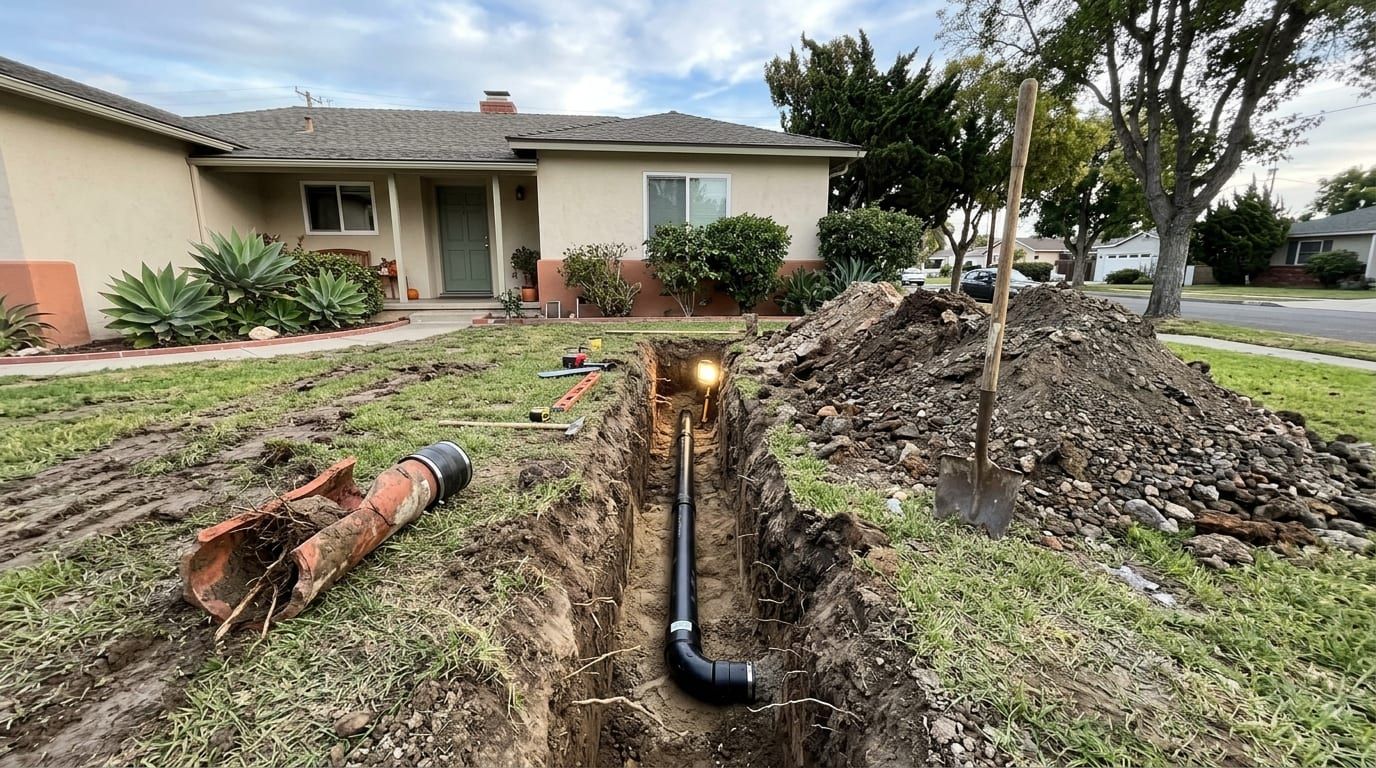
Trenchless sewer repair means rebuilding your sewer lateral without opening the ground along its whole length. Two small access points, often one pit near the house and one out towards the property line, stand in for forty or sixty feet of trench. As for what it costs, nobody can give you a real figure over the phone, and anyone who does is guessing. The number is set by what the camera finds, how deep the pipe sits, what it is made of, how far it runs to the district main and whether a permit is involved. We film the line first, then talk.
The two methods that get called trenchless
Two techniques do most of the work in Orange County. They are not interchangeable, and the camera survey is what decides whether either is even possible.
Cured-in-place lining
A resin-saturated liner is pulled or inverted into the existing pipe, inflated against the wall and cured in place. What you end up with is a new pipe formed inside the old one, using the old pipe as a mould. Lining suits a run that is still structurally continuous: cracked, scaled, invaded at the joints, but holding its shape and holding its line. Every branch connection the liner covers has to be reopened afterwards with a cutter, so the number of live branches on the run is part of the work.
Pipe bursting
A bursting head is winched through the old pipe on a cable or rod. It splits the old wall outward into the surrounding soil and drags a new pipe in behind it. This replaces the pipe rather than relining it, and it can go up a size. It needs a pull pit at each end and enough room around the pipe for the fragments to go somewhere. Clay bursts cleanly. Cast iron is harder work. A pipe that has already collapsed and shifted off line may leave nothing for the head to follow.
What has to be true before either one works
Trenchless is not a way of skipping the diagnosis. It is a way of avoiding a trench once the diagnosis is done. The line has to be passable end to end by the camera, or mapped well enough that we know exactly where it stops and why. A belly, meaning a section that has settled so waste stands in it, will still be a belly after lining, because a liner follows the pipe it is formed inside. A joint that has separated with the ends stepped out of line gives a liner a ledge it can bridge but cannot seal. Those are the cases where the honest answer is to open the ground at one spot rather than line the whole run.
Where a Costa Mesa lateral actually goes
The Costa Mesa Sanitary District maintains the main. You own the lateral, all of it, from the house out to the point where it meets that main, which is usually under the middle of the street. That is a longer stretch of private pipe than most people expect, and it is the main reason two houses on the same block get very different answers. A lateral that connects near the kerb line is a different job from one that crosses two lanes of asphalt to a main under the centreline, even when the pipe itself is identical.
Age tells you the material. Costa Mesa’s median build year is 1972 and 68% of the housing stock went up before 1980, so the common find under these streets is cast iron out of the building and clay beyond it, with a transition somewhere near the foundation. Clay joints are the doorway roots use. Cast iron corrodes from the inside until the bottom of the pipe is a channel through rust rather than a pipe wall. Which of those two you have changes what a liner is being asked to do, and sometimes rules lining out altogether.
What actually moves the number
This cannot be priced from a description of the symptoms. These are the things that decide it, and every one of them is something that can be seen or measured before a figure is put on paper.
A real figure needs somebody at the property with the survey already done. A number produced before that has been chosen to sound good on a phone call, and it will move once the ground is open.
When open trench is still the right call
Trenchless is not automatically the smaller job. If the failure is one cracked section a few feet from an accessible cleanout, digging that one hole and replacing that one length is faster and less disruptive than lining sixty feet of pipe that is otherwise sound. We say so when that is the case. Selling a full rebuild off the back of a single bad joint is the easiest upsell in this trade and the least defensible one.
The reverse is also true. A cast iron line scaled shut along its length, with the invert already gone, cannot be repaired a section at a time. Patching that buys weeks, and the second call always costs more than doing it once.
How to judge the estimate you are handed
Ask which method is being proposed and why the other one was ruled out. There is always a reason, and it should be a reason about your pipe rather than about the equipment on the van. Ask where the pits go and what the ground looks like after backfill. Ask who is pulling the permit and under which agency.
Then ask what happens if the line turns out worse than the survey suggested once it is open. Every contractor hits that occasionally. What separates them is whether the answer was agreed in advance or invented on the day.