
Sewers & repiping
Which trenchless method suits your sewer lateral
Two trenchless methods solve two different problems. One rebuilds a pipe inside the old one, the other destroys the old pipe and pulls a new one through the space. What the camera finds on your line settles which of them is even an option.
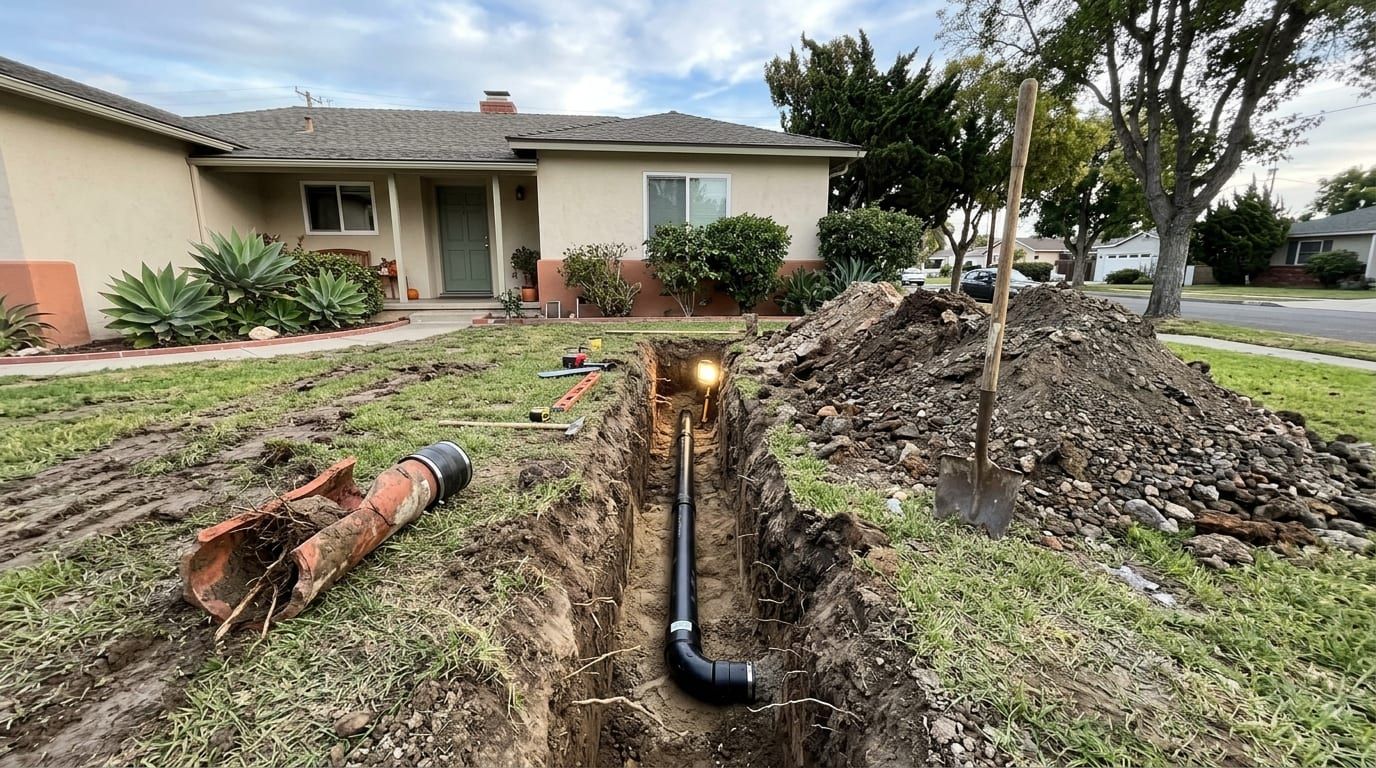
Lining wins when the old pipe still holds its shape and still has the diameter to spare. Bursting wins when the pipe has collapsed, lost bore to scale, or needs to come out a size larger. Neither one is an upgrade on the other in the abstract. Cured-in-place lining builds a new jointless pipe inside the old one. Bursting splits the old pipe outward into the soil and drags a new pipe through the space it leaves. A camera survey decides which is possible, and on a Costa Mesa lateral the answer also depends on how far the run continues past the kerb before it meets the district main.
What lining does inside the old pipe
A cured-in-place liner is a felt or fibreglass tube saturated with resin. It is inverted into the pipe under air or water pressure, or winched in and inflated, then held against the pipe wall while the resin cures with hot water, steam or ultraviolet light. What sets is a pipe in its own right, with no joints for roots to find and no offsets for paper to catch. Because the liner takes its shape from the host pipe, everything wrong with the host pipe’s line and grade stays wrong. A liner follows a sag. It does not lift one.
The trade is diameter, since the liner has thickness and that thickness comes off the inside. On a four-inch lateral running full bore, the smoother wall usually gives back more flow than the liner takes. On a pipe already choked by fifty years of cast iron scale the sum looks different, and the remaining bore should be measured on camera rather than assumed. Lining also needs access at both ends and a clean, reamed host pipe before the tube goes in, so descaling with a cutter or a jetter is part of the work rather than an extra.
What bursting does to the old pipe
Bursting pulls a cone-shaped head through the old pipe on a cable or a string of rods, winched from a pit at the far end. The head is wider than the old bore, so clay or cast iron fractures and the pieces are pushed out into the surrounding soil. A fused HDPE pipe is towed in immediately behind the head and arrives as one continuous length with no couplings underground. Clay shatters cleanly. Cast iron breaks well enough. Both are good candidates for the method.
What bursting needs is room and a pit at each end. The fragments have to go somewhere, and so does the displacement of a larger new pipe, which puts anything running close alongside the lateral at risk: the water service, the gas line, irrigation, a neighbour’s line laid across yours decades ago. Potholing to expose those crossings before the pull is the difference between a clean job and a gas call. Bursting also stalls on anything the head cannot break, such as a steel repair band from an old dig, a section encased in concrete, or a stretch someone already lined.
What the camera decides
Before either method is priced the line gets filmed, and the operator is answering a short list of questions rather than sightseeing. What is the material, and does it change part-way along? Where are the joints and how far are they offset? Is there standing water, and if so how long and how deep is the pool? How much of the bore is scale and how much is a lump that could be cut out? Where does the run go and how deep is it, traced from the surface with a sonde? A survey that does not end with a location and a depth is half a survey.
A belly is a grade problem, not a pipe problem
Standing water in a filmed line means the pipe has lost its fall, usually because the soil beneath it settled. Line it and you get a smooth pipe that still holds water. Burst it and you get a new pipe following the same trench, holding water in the same place. The only fix that changes the answer is opening that section and re-bedding it to grade. A contractor who films a pool and quotes a full-length trenchless job without mentioning it either did not look or is hoping you did not.
Your lateral does not stop at the kerb
In Costa Mesa the sewer lateral belongs to the property owner all the way to the point of connection with the Costa Mesa Sanitary District main, and that main normally sits under the middle of the street. The section under the roadway is the deepest part of the run and the part carrying traffic load, and in a city where the median house dates from 1972 it is the same age as everything else in the ground. A trenchless quote that quietly stops at the property line leaves that section in place. Ask where the price ends, in feet, and have it written down.
Work in the roadway also changes the shape of the job, bringing in the city, traffic control and trench restoration, which is one reason a receiving pit sometimes goes in the parkway instead. The district runs a rebate programme covering a CCTV inspection of the lateral or the installation of a ground-level cleanout. It is worth checking before you pay for a survey out of pocket, and a cleanout at the property line makes every future visit quicker and less invasive.
Conditions that rule one method out
Most laterals could take either method. These are the findings that settle it before anyone argues preference.
Open-cut still wins some jobs
If the camera shows one bad joint six feet from the house and forty feet of sound pipe behind it, the right job is a spot repair: a short trench, the section cut out, new pipe and couplings, backfill. Trenchless methods earn their keep on long runs, deep runs, and runs under a driveway, a mature tree or a finished patio. Through open lawn a dig is often faster, easier to put right afterwards and easier to inspect, because you can see the finished pipe with your own eyes before it is covered. Being handed the smaller job is not a consolation prize.
What to settle before anyone starts
Get the video itself, not a description of it, with the footage counter running, so a second opinion is possible without re-filming. Have the quote state the method, the start point, the end point in feet, and what happens if the burst head stalls or the liner wrinkles part-way, because that contingency is where a fixed number quietly becomes an open one. Ask who pulls the permit and who is responsible for the surface afterwards: lawn, driveway apron, roadway patch. Ask whether a cleanout is included and where it will sit.
Then film it again. A post-job camera pass down the finished pipe is the only record that the liner cured tight to the wall through the whole run, or that the new pipe pulled through without a snag at the last joint. Keep both files with the permit paperwork. If you sell the house, the video is the part a buyer’s inspector cannot argue with.