
Repairs
The things that decide what a repair takes
A real figure for a plumbing repair needs somebody to see the job, and that is not evasion. Four things set the work, none of them are visible over the phone, and knowing what they are lets you read a quote properly.
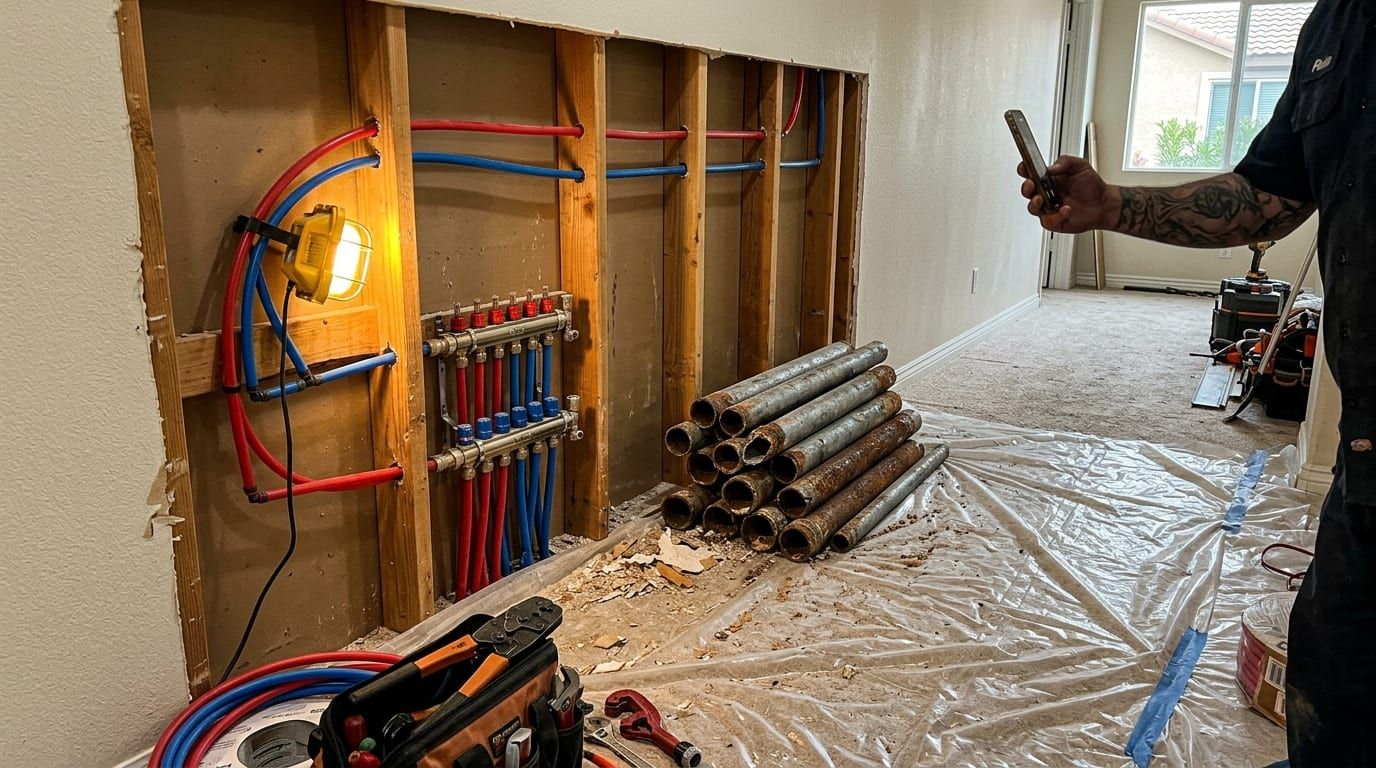
Beyond a straight fixture swap, nobody can give you a number down the phone that is worth relying on. The work is set by how hard the pipe is to reach, what the pipe is made of, how much of the run has to be opened up, and whether the job is permitted work. Two houses on the same Costa Mesa street can present the identical symptom, a slow drain or a damp patch on the floor, and end up as completely different jobs once somebody has actually looked. What follows is what moves the work, so you can judge whether a quote is describing your house or a generic one.
Access moves it more than the part does
The part in a repair is rarely the significant half. Getting to the part is. Slab-on-grade construction is the norm across Orange County, so a supply line failure under a living room floor is not a pipe job with a bit of digging; it is a decision between cutting and restoring concrete at a located point, or abandoning the line and re-routing it overhead through the attic and back down.
The same fault behind a bathroom vanity is an hour with the doors open. In a crawl space it is awkward but reachable. Inside a finished wall it brings in cutting, dust control and putting the wall back afterwards. When two quotes for the same symptom look nothing like each other, access is usually why, and it is fair to ask which route each one has assumed.
What the pipe is made of, and what era it came from
Material decides how the work is done and how much of the surrounding pipe survives being disturbed. Costa Mesa’s median build year is 1972, and most of the city was built before 1980, so the middle two lines below cover the majority of what is in the walls locally.
Clay and cast iron laterals are the two materials that most often turn a repair into a replacement, because they fail along their length rather than at one identifiable point.
How much has to be opened, and where the run actually ends
On a sewer job in Costa Mesa this is the question that dominates everything else. The Costa Mesa Sanitary District operates the mains, but the homeowner owns the lateral all the way to the point of connection with the district main, and that connection is usually under the middle of the street.
So a lateral fault ten feet from the house and a lateral fault at the connection are the same pipe and completely different jobs. The second one involves depth, other buried utilities, working in the roadway and everything that comes with opening a street. This is exactly why filming the line before recommending anything is not a formality. The location of the defect along the run is the single largest variable in the work.
Whether it is permitted work
Water heater replacement, repiping and sewer replacement are permitted work through the city building department, or through Orange County on unincorporated land such as North Tustin, Coto de Caza, Ladera Ranch, Rossmoor and Rancho Mission Viejo.
A permitted water heater installation is inspected against a specific list: two seismic straps anchored into structure, a drip pan with a drain line run to somewhere sensible, a full-size temperature and pressure relief line terminating near the floor with no valve anywhere in it, correct venting, a sediment trap on the gas line, and an expansion tank where the system calls for one. Every item on that list is labour and material. If one quote is markedly lighter than another, that list is often where the difference lives, and asking which of those items is included tells you a lot.
What the camera finds changes the job
On any recurring drain problem, the sequence should be camera first, recommendation second, and you should be looking at the screen while it happens. A single root intrusion at one joint is a spot repair. A run that has bellied so water stands in it, or cast iron that has delaminated along its length, is not repairable at one point no matter how the estimate is written.
The Sanitary District runs a rebate programme covering a CCTV video inspection of the lateral or the installation of a ground-level cleanout, and it is worth checking the current terms with the district directly before any work is scheduled. A cleanout is also the quiet hero of drain work: without one, access has to be found through a roof vent or a pulled toilet every single time.
This is also where the difference between clearing methods shows up in the estimate. Cabling cuts a channel through a blockage and gets flow back today. Hydro jetting scours the pipe wall back to bare material. On fifty-year-old cast iron the obstruction is often a lining rather than a lump, which is why the same drain backs up three weeks after it was snaked, and why the cheaper visit sometimes turns out to be the more expensive year.
The hour on the clock, and whether it can wait
Some things genuinely cannot wait until morning: sewage coming back into the house, water you cannot isolate because no shut-off will close, water near an electrical panel, or a supply failure running unchecked. Those are night calls and they cost more to attend, which is true of any trade.
Plenty of things can wait. A dripping faucet with a working angle stop under it, a single slow drain in a house with other bathrooms, a water heater that is producing hot water but weeping slightly from a fitting. Being told plainly that a job can wait until morning is worth more than being talked into a midnight visit, and the phone here is answered by a person at any hour whether the answer is come now or set an appointment.
Questions that get you a straight answer
Have this ready before you pick up the phone
Age of the house, or as close as you know it. What you can actually see, and a photo of it. Whether the shut-off valve at that fixture closes. Whether other fixtures are affected. When it started, and what happened just before. Any label or data plate on the water heater or the fixture, photographed rather than transcribed.
None of that produces a number over the phone, and it should not. What it does is get the right van, the right parts and the right amount of time booked for your house, which is the part of an estimate that most often goes wrong before anyone has even arrived.