
Water heaters
What a tankless rebate really asks of your install
Rebate programmes for high-efficiency tankless heaters open, close and rewrite their qualifying lists from one year to the next. What stays constant is the evidence a claim needs, the permit that has to exist anyway, and the parts of the job no rebate touches.
The short answer on gas utility rebates
The gas utility does run residential efficiency rebates, and high-efficiency tankless water heaters have been on that list for years. What it pays, and which models qualify, changes with the programme year. That is why there is no figure on this page. Funding pools run dry mid-year, efficiency thresholds move up, and a number written here in one season would mislead somebody reading it in the next. Look at the utility’s own current residential rebate catalogue in the week you are buying, and read the qualifying model list rather than the summary page. The list is the part that decides.
The second thing worth knowing early is that a rebate is a reimbursement on a job you have already paid for and had inspected. It is not a discount at the counter. The sequence matters: buy a model that is on the list on the day of purchase, pull the permit, get the final inspection, keep the invoice, then claim.
What the claim form asks for
Forms differ from year to year, but the evidence they want has been stable for a long time. Before the van leaves your driveway, make sure you can produce all of this.
The permit is part of this, not an extra
Water heater replacement is permitted work. In Costa Mesa it goes through the city building department. If the house sits on unincorporated county land, which covers North Tustin, Coto de Caza, Ladera Ranch, Rossmoor and Rancho Mission Viejo, it goes through Orange County instead. Fees and turnaround are set by those agencies and change without announcement, so ask them rather than a plumber’s website.
People sometimes ask whether the permit can be skipped to save a week. Beyond the obvious problem, skipping it removes the rebate, because the inspection record is what proves the install exists and was done correctly. It also follows the house. A missing permit on a gas appliance tends to surface at the worst moment, when the property is being sold and an inspector asks why the flue size changed and nobody can produce a card.
The parts of the job a rebate does not touch
A rebate is written against the appliance. The work that makes that appliance legal and functional in your particular house is yours. In a Costa Mesa home built around 1972, which is the median build year here with 68 per cent of the housing stock finished before 1980, that work is usually where the real money sits.
Gas supply
A storage heater and a high-output tankless do not ask the same thing of the gas system. A tankless fires hard and instantly, and the line feeding it has to carry that demand alongside the furnace, range and dryer already on the meter. Sometimes the existing run is adequate. Sometimes it is not, and the fix is a larger line back toward the meter. That gets measured, not guessed, and no rebate covers it.
Venting and condensate
A condensing tankless does not reuse the old atmospheric flue. It vents through its own sealed pipe, usually out a sidewall, and it produces acidic condensate that has to drain somewhere and often be neutralised first. In a garage there is normally a path. In a hallway closet in an older tract house there may not be, and that single constraint can decide the whole job.
Power at the unit
Even a gas tankless needs an electrical outlet for its controls and fan. Old water heater locations rarely have one within reach, and adding it is electrical work on its own.
Groundwater and the efficiency you are being paid for
Mesa Water District supplies most of Costa Mesa entirely from local groundwater, pumped from nine wells into the Orange County basin. Deep well water here carries an amber colour from ancient decomposed redwood, which is removed at the Mesa Water Reliability Facility before delivery. What treatment does not remove is the mineral content that comes with groundwater, and mineral is what plates out inside a heat exchanger.
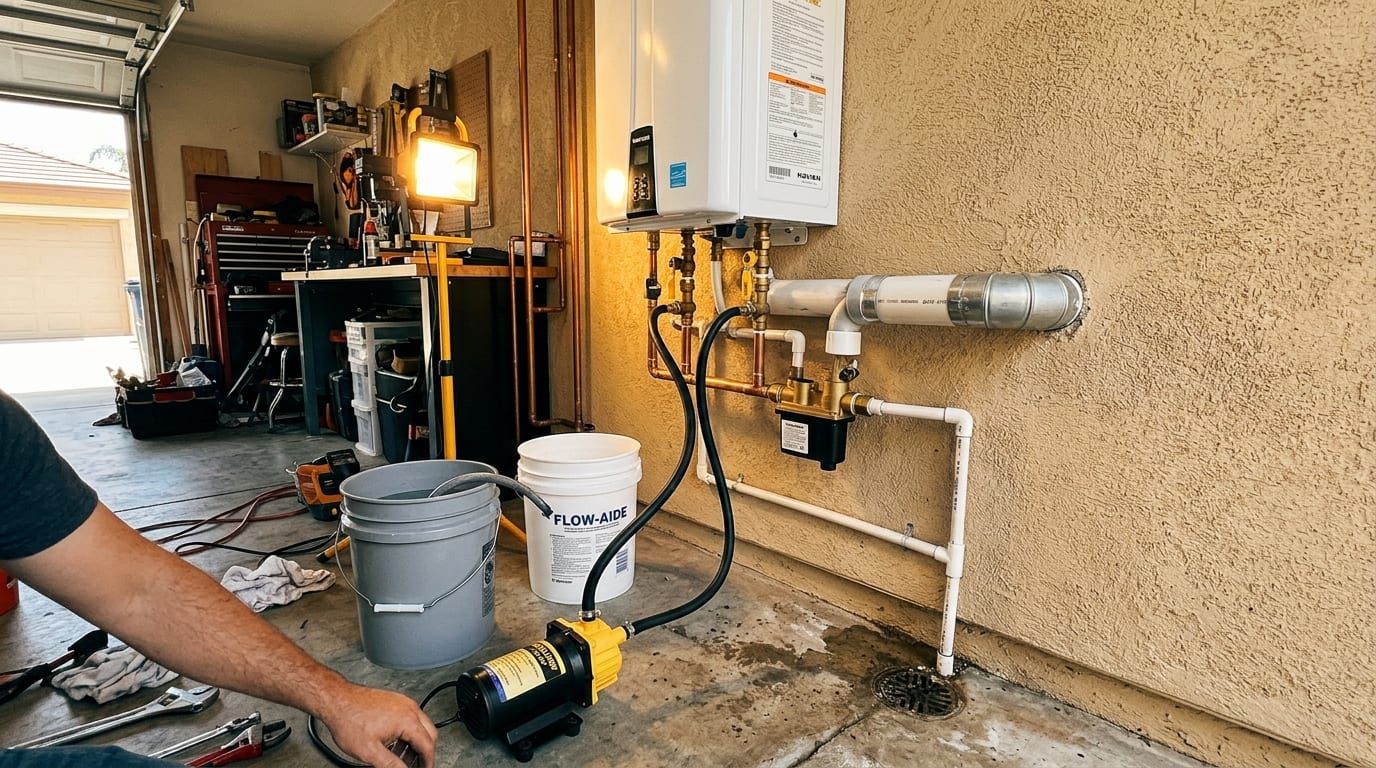
That matters directly to a rebate conversation. The efficiency rating that qualified the unit is the rating of a clean exchanger. Scale on the exchanger wall acts as insulation between the flame and the water, and the unit answers by firing longer. A tankless installed here without isolation valves for descaling will quietly drift away from the number printed on its own label. Ask for the service valves. They are cheap during the install and awkward to add afterwards.
A different rebate, from a different district
While you are reading programme pages, there is a local one that has nothing to do with the water heater and gets far less attention than it deserves. The Costa Mesa Sanitary District runs a rebate towards a CCTV video inspection of your sewer lateral, or towards installing a ground-level cleanout. The amount is published by CMSD, not here.
It is worth knowing because in Costa Mesa the homeowner owns the lateral all the way to the point of connection with the district main, which usually sits under the middle of the street. Most people learn that on the day it fails. Filming the line while nothing is wrong is the cheapest look you will ever get at it.
Deciding without letting the rebate decide
A rebate should tip a decision that was already close. It should not make the decision. If a tankless suits the house, meaning the gas can feed it, the venting has a path and someone will actually descale it, then the rebate is a bonus on a sound job. If those things are not true, money back on the box does not fix them.
The check that settles it takes about an hour: look at the meter and the existing gas run, trace where a sealed vent could exit, and read what the old heater’s condition says about the water it has been drinking. Tank against tankless has its own article on this site, and it is the more useful question of the two.