
Water heaters
What a code-compliant replacement has to include
A replacement is more than setting a new tank where the old one stood. Here is what the finished install has to include, who issues the permit, and why water drawn from local wells is hard on a heater in this city.
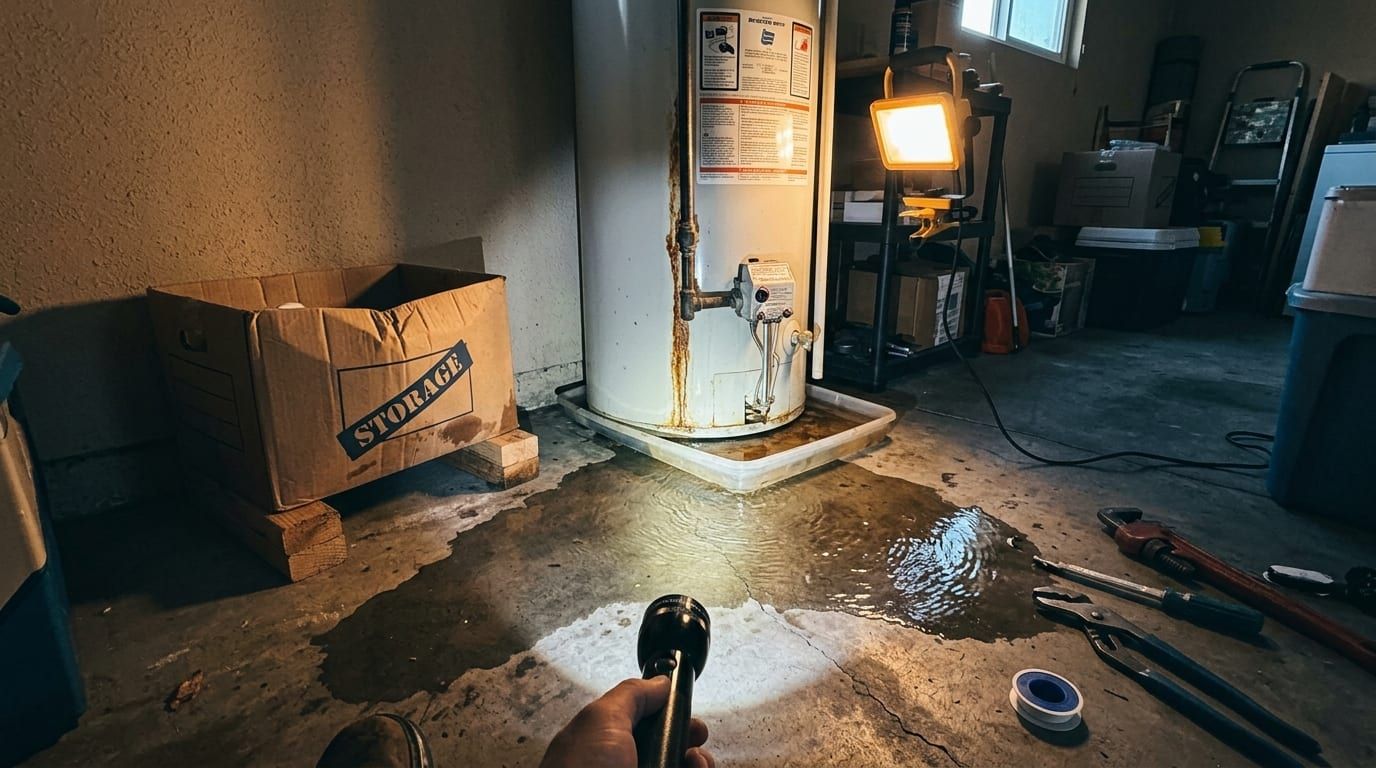
If the heater has failed and you want to know what a replacement involves: it is permitted work through the building department, most straightforward swaps are finished inside a working day, and the completed job has to include two seismic straps anchored to structure, a drip pan with a drain line, a full-size temperature and pressure relief line ending near the floor with no valve in it, correct venting, a sediment trap on the gas line, and an expansion tank where the system requires one. Anything short of that list is not a finished install, however quickly it produced hot water.
What the old tank tells us before it comes out
The rating plate carries the manufacture date, the input rating and the first-hour rating. Those three numbers say whether the unit that just failed was ever the right size for the household, or whether the family has been living with a shortfall for years and blaming the heater for it. We also look at what is feeding the thing: the size of the gas line, the condition of the vent connector, the state of the flex connectors on top, whether a pan exists and whether that pan drains anywhere useful. A replacement that faithfully repeats the previous installer’s mistakes is a wasted day.
Costa Mesa water is groundwater, and groundwater leaves deposits
Mesa Water District supplies most of the city entirely from local groundwater, drawn from nine wells into the Orange County basin and treated at the Mesa Water Reliability Facility before it reaches the street. The deep well water carries an amber colour from ancient decomposed redwood, and that colour is taken out at the facility. What treatment does not change is the mineral character of groundwater, and mineral is the part that matters to a water heater.
Heat drives dissolved mineral out of solution. Inside a tank it settles on the floor of the vessel, directly above the burner, and it builds in layers. A tank carrying a sediment bed takes longer to recover, rumbles and pops as trapped water flashes to steam underneath the deposit, and runs its steel hotter than the design intends because the deposit insulates the water from the flame. That is the local reason a heater here can wear out faster than the identical model in a town supplied from a reservoir.
Where the heater lives decides half the job
Garage
The most common location in a city of 44,427 housing units where 39 per cent of homes are detached single-family. Garages are the easiest place to work, but they are also where a pan drain has the furthest to travel before it reaches daylight, and where a vehicle parks a few feet from a gas appliance. Clearance around the unit, a route for the pan drain and protection from impact all get settled before anything is set in place.
Hall closet or interior cupboard
Interior installs are tight, and the pan matters more here than anywhere else, because a failure lands on flooring rather than on a slab that slopes towards an open door. Door width often decides which model can be used at all. We measure the opening before ordering rather than after, since a tall unit that will not pass the frame turns a one-day job into two.
Exterior enclosure
Weather protection, venting and the condition of the enclosure itself all come into it. Enclosures on older properties are usually the original ones, sized around the original heater, and the original heater was smaller than most of what is sold today.
Six things a finished install has to include
Who issues your permit depends on which side of a line you live on
Water heater replacement is permitted work. Inside Costa Mesa that runs through the city building department. If the property sits on unincorporated county land, which includes North Tustin, Coto de Caza, Ladera Ranch, Rossmoor and Rancho Mission Viejo, it goes through Orange County instead and the inspection is scheduled with the county. The distinction catches people out, particularly in the pockets where unincorporated land sits inside a city mailing address. Ask who is pulling the permit and when. A permit that was finalled is what a buyer’s agent will go looking for years from now.
What moves the number on a replacement
The heater itself is rarely the interesting part. What moves the total is the work around it: whether the gas line is adequate for the new input rating, whether venting has to be reworked, whether a pan and a drain already exist or have to be created, whether an expansion tank is needed, how far the unit has to be carried, and what the existing connections are made of. A galvanised nipple that has been in service since the 1970s does not come apart quietly.
We do not give a replacement figure over the phone, because the only honest sight-unseen answer is a range wide enough to be useless to you. Somebody looks at the installation, at what feeds it and at where the new unit has to go, and then you get a figure for the job actually in front of you.
When the smaller job is the right one
Not every failure is a replacement. A thermocouple, a gas control valve, a burner assembly, a dip tube, a weeping relief valve — these are repairs, and on a heater only a few years old they are usually the correct repairs. The judgement turns on the date on the rating plate, on whether the tank itself is sound, and on whether the same part has already been replaced once before. If the tank is intact and the unit is young, we will say so and fix the part.
Tank, or is this the moment for tankless
A tankless conversion is a different job with different requirements. Gas supply, venting and condensate all change, and the descaling that groundwater makes necessary becomes an annual appointment rather than an optional extra. It suits some houses very well and others poorly. That decision deserves its own conversation, and it is not one to settle on the driveway while the old tank is draining.
Worth doing on the day
One more habit worth forming. Put a reminder in the calendar a year out to flush the tank. On local groundwater that flush is not a manufacturer’s suggestion to be politely ignored. It is the difference between a heater that reaches the life it was built for and one that spends its final years working through a bed of mineral.