
Drains
Grease in the kitchen line, and what actually removes it
A grease clog is removed mechanically, not chemically. Here is the part a homeowner can safely do under the sink, the part that needs a machine, and how to tell which one you are dealing with before you buy anything.
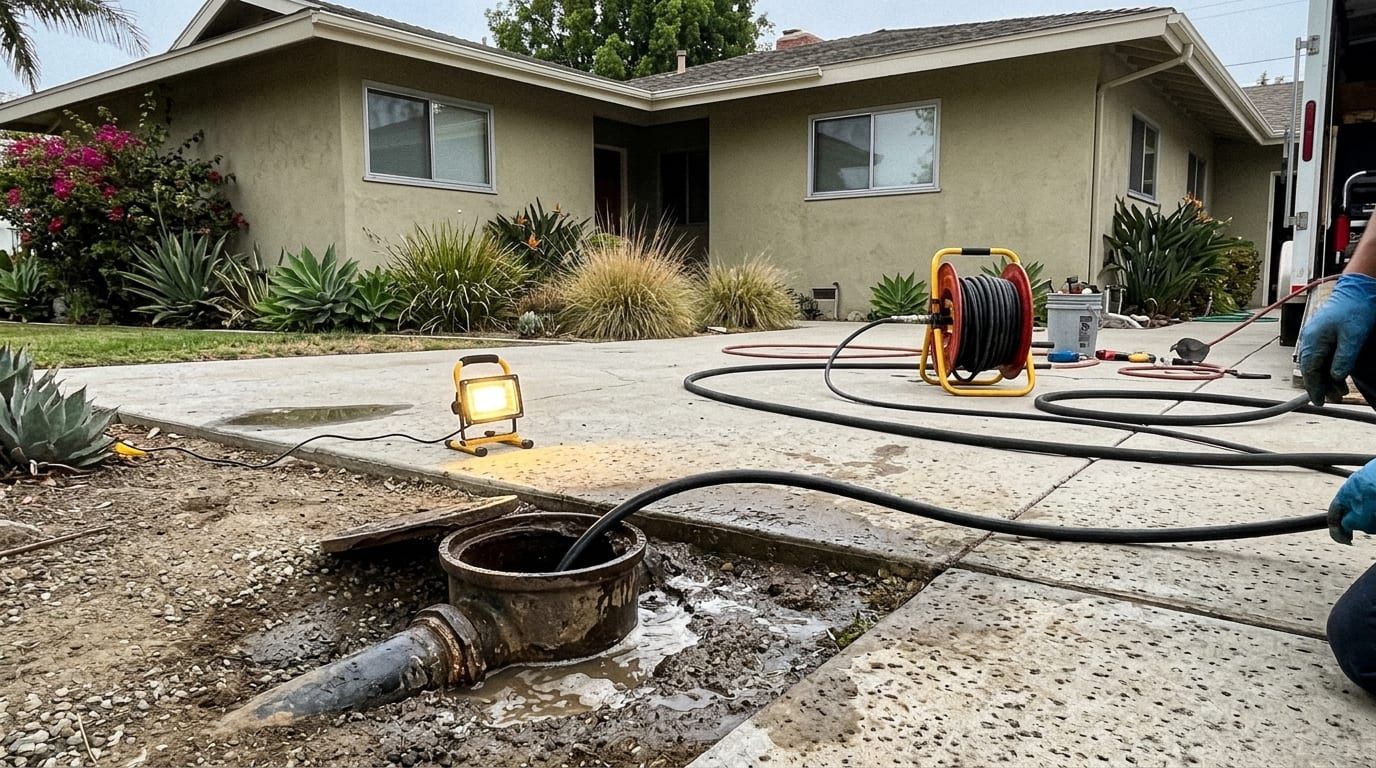
Clear what you can reach by hand. That means the P-trap under the sink and the short tailpiece above it, with a bucket, a pair of slip-joint pliers and hot tap water. Leave caustic and acid drain openers on the shelf: they turn a slow sink into a basin of standing chemical that still will not drain, and they make the pipe dangerous for whoever opens it next. If the sink runs freely after the trap is cleaned and then slows again a few weeks later, the grease is downstream, coating the pipe wall, and nothing you do under the sink will reach it.
Why grease sets like candle wax inside the pipe
Grease leaves the pan as a liquid. It does not stay one. Warm fat rides the water a few feet, meets pipe sitting at ground temperature, and comes out of suspension onto the wall. Dish soap emulsifies it just long enough to carry it past the trap, then lets go of it further along. Every wash adds a film. Coffee grounds, rice starch, detergent and shreds of food bind into that film, and over a few years the inside of a two-inch kitchen branch can close down to the width of a pencil.
That is why the failure feels sudden after years of nothing. The line copes and copes, then one roasting tin finishes it. The lump that finally stopped the water is rarely the whole problem. It is the last spoonful of fat that bridged an opening which had been narrowing since the house was built.
Pulling the P-trap: the part you can do yourself
On a kitchen sink this is genuinely a homeowner repair. Everything past the wall needs a machine and someone who can see what is in there.
Scrape the waste into the bin. Do not rinse the trap in that same sink, or in the bath, or over a garden drain. All that does is move the grease a few feet along the pipe and hand the problem to a fixture you use every day.
Why boiling water and drain chemicals do not fix it
Boiling water
A kettle of boiling water melts the grease it touches and sends it on. It cools within a few feet and the fat sets again somewhere colder, usually in a horizontal run you cannot get to. On plastic waste it also softens the trap and can loosen a slip-joint seal that was fine that morning. It buys a day or two and it moves the problem out of reach.
Caustic and acid openers
Caustic products react with fat and generate heat, which is exactly why they seem to work at first. The reaction stops as soon as the product dilutes, and what is left is a partly converted soap sitting on top of the original blockage. In a sink already holding water, the chemical never reaches the clog at all. Acid products attack old cast iron waste from the inside while they are at it, and that is the pipe most kitchens in this city drain into.
Enzyme treatments
Enzyme and bacterial products are maintenance, not rescue. They work slowly on organic film in a line that is already flowing, and they do nothing to a drain that is standing full tonight. If you want to use one, use it after the line has been cleaned properly, not instead of cleaning it.
When the trap is clean and it still backs up
At that point the answer stops being a guess and starts being a picture. Put a camera down the line and look at the wall of the pipe. A greasy kitchen branch has a signature you can see on the screen: a rolled, waxy shoulder narrowing the bore evenly rather than one object lodged in one spot. If the camera instead shows roots at a joint, a bellied section holding water, or a broken hub, then grease was never the story and cleaning it will not last.
Cabling clears a channel; jetting cleans the wall
A cable drills a hole through the middle of an obstruction. Water rushes through, the sink drains, everyone is satisfied, and the coating on the pipe wall is still exactly where it was. Hydro jetting scours the wall back to bare material with water pressure. On the fifty-year-old cast iron under a lot of Costa Mesa houses the blockage is a lining rather than a lump, and that is the whole reason a drain that was snaked comes back three weeks later. When the same fixture fails on a schedule, the schedule is telling you the wall was never cleaned.
Costa Mesa kitchens: cast iron, and a lateral that ends in the street
The median Costa Mesa home was built in 1972 and 68 percent of the housing stock went up before 1980, which puts most kitchens on copper supply and cast iron waste. Cast iron corrodes to a rough, scaled inner surface, and rough surfaces hold grease the way a file holds sawdust. The other local detail matters once the problem is past the house: under the Costa Mesa Sanitary District, the homeowner owns the sewer lateral all the way to the point of connection with the district main, and that is usually under the middle of the street. So a kitchen line that keeps failing can be a homeowner problem for a surprisingly long distance. CMSD runs a rebate programme covering a CCTV inspection of that lateral or the installation of a ground-level cleanout, which is worth checking before anyone starts digging.
Signs the grease has moved past the kitchen branch
What keeps a kitchen line open afterwards
One thing worth sorting out before you need it: find out whether the property has a ground-level cleanout, and if it does not, that is the first thing to fix. Access decides everything that follows, including whether a line can be cleaned from outside instead of through a sink cabinet. Ask to see the camera footage of your own line as well, and keep the file. Next time a drain slows, the comparison between that recording and a fresh one answers in a minute what otherwise takes an afternoon of guessing.