
Drains
Five signs the blockage is in your main sewer line
A single slow sink is a local problem. When two fixtures react to each other, when the lowest drain in the house floods first, or when the yard cleanout is holding water, the blockage has moved downstream into the line you own.
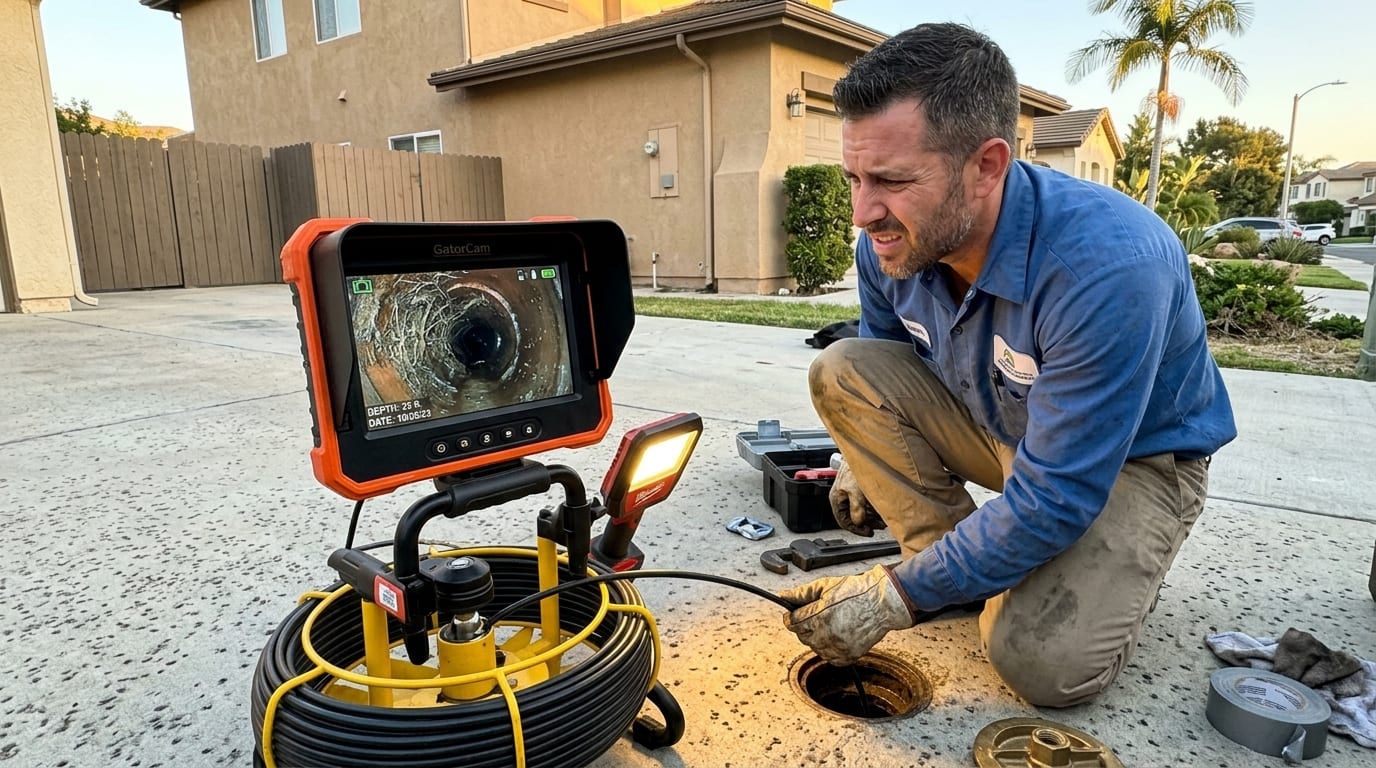
If only one fixture is affected, the blockage is in that fixture’s own branch. If two or more fixtures react to each other, or if the lowest drains in the house are the ones flooding, the blockage is in the main line carrying everything out to the street. That difference decides everything after it. A local clog is a trap and an arm and usually a short job, while a main line blockage sits in the pipe you own between the house and the district main. The five signs below tell you which one you have before anybody opens anything.
Sign one: two fixtures that have nothing to do with each other
A slow bathroom sink is a bathroom sink. A slow bathroom sink and a slow kitchen sink on the other side of the house, in the same week, are one blockage downstream of both. Waste from every fixture eventually joins a single pipe, so when symptoms appear in rooms that share nothing except that pipe, the shared pipe is the suspect. Go and check the fixtures you are not thinking about: the guest bathroom, the laundry standpipe, a floor drain in the garage.
Sign two: the toilet reacts when the washing machine empties
This one comes close to diagnostic. A washing machine dumps a large volume in a short burst. If the main line is partly blocked, that surge has nowhere to go and pushes air back up the nearest opening, which is usually a toilet bowl. You see the water level rise and fall, or you hear it bubble, a few seconds after the machine starts to drain. A toilet responding to an appliance in another room is reporting on the line they both feed.
Sign three: the lowest drain floods first
Water finds the lowest exit. In a single-storey home on a slab that is normally the shower or tub in the bathroom nearest the front of the house, or a garage floor drain. In a two-storey home it is a downstairs fixture, and running an upstairs bath is what fills it. If flushing a toilet puts water into a shower pan, stop using the fixtures. Every further flush adds to whatever has to come back out.
Sign four: gurgling from a fixture nobody has touched
Gurgling is air being pulled or pushed through a trap. When a drain runs normally, air comes down the vent stack on the roof to replace what the water displaces. When the main line is restricted, water backing up shoves air sideways instead, and it escapes through the nearest trap seal, bringing sewer gas with it. A smell in a room where nothing has been used, with a gurgle to go with it, points downstream rather than at that fixture.
Sign five: water standing at the cleanout outside
Most homes have a cleanout, a capped fitting at ground level, often near the front of the building or by the side gate, sometimes a two-way fitting. If you lift the cap and water is sitting in it, the blockage is on the street side of that point. If it is dry while the house is backing up, the blockage is between the house and the cleanout. That single observation narrows the search more than anything else you can do without equipment, and it is the main reason a cleanout is worth having.
Lift the cap carefully and stand to one side. A line under pressure releases when the cap comes off, and what comes out is raw sewage.
What to do in the first ten minutes
The first minutes matter because a main line blockage gets worse with use, not with time. Everything sent down the pipe while it is blocked comes back somewhere lower.
Where your pipe ends and the district’s begins
In Costa Mesa, sewer service is the Costa Mesa Sanitary District. The homeowner owns the lateral all the way to the point of connection with the district main, and that connection is usually under the middle of the street. People are regularly surprised by this. The section of pipe under the kerb, the parkway and half the road surface is theirs to maintain. CMSD runs a rebate programme covering a CCTV video inspection of the lateral or the installation of a ground-level cleanout, which is worth looking into before you commission either one.
What the camera decides
All five signs above tell you the blockage is in the main line. None of them tell you what it is, and the answer changes the work completely. Roots at a joint, a grease build-up, a section that has sagged into a belly and holds water, an offset where two lengths of clay have shifted: each of those looks identical from inside the house. Homes built before 1960 typically have clay laterals and cast iron waste, while the 1960s and 1970s stock, which is most of Costa Mesa given a median build year of 1972, is cast iron. Roots take joints. Cast iron scales.
So the sequence is camera first, recommendation second. A line simply loaded with soft blockage gets cleared and filmed again to confirm bare pipe. A line with a belly in it will not stay clear no matter how it is cleaned, and it is more honest to say that than to sell a cleaning every spring.
Write down the date and what you saw: which fixtures, in what order, and whether the cleanout held water. If it happens again in six months, that note is the difference between a guess and a pattern.