
Drains
Steps that work on a blocked kitchen sink, in order
Most kitchen blockages sit within two feet of the sink, which puts them inside reach of a plunger and a bucket. This is the order to work through, and the point at which carrying on yourself starts costing you more than it saves.
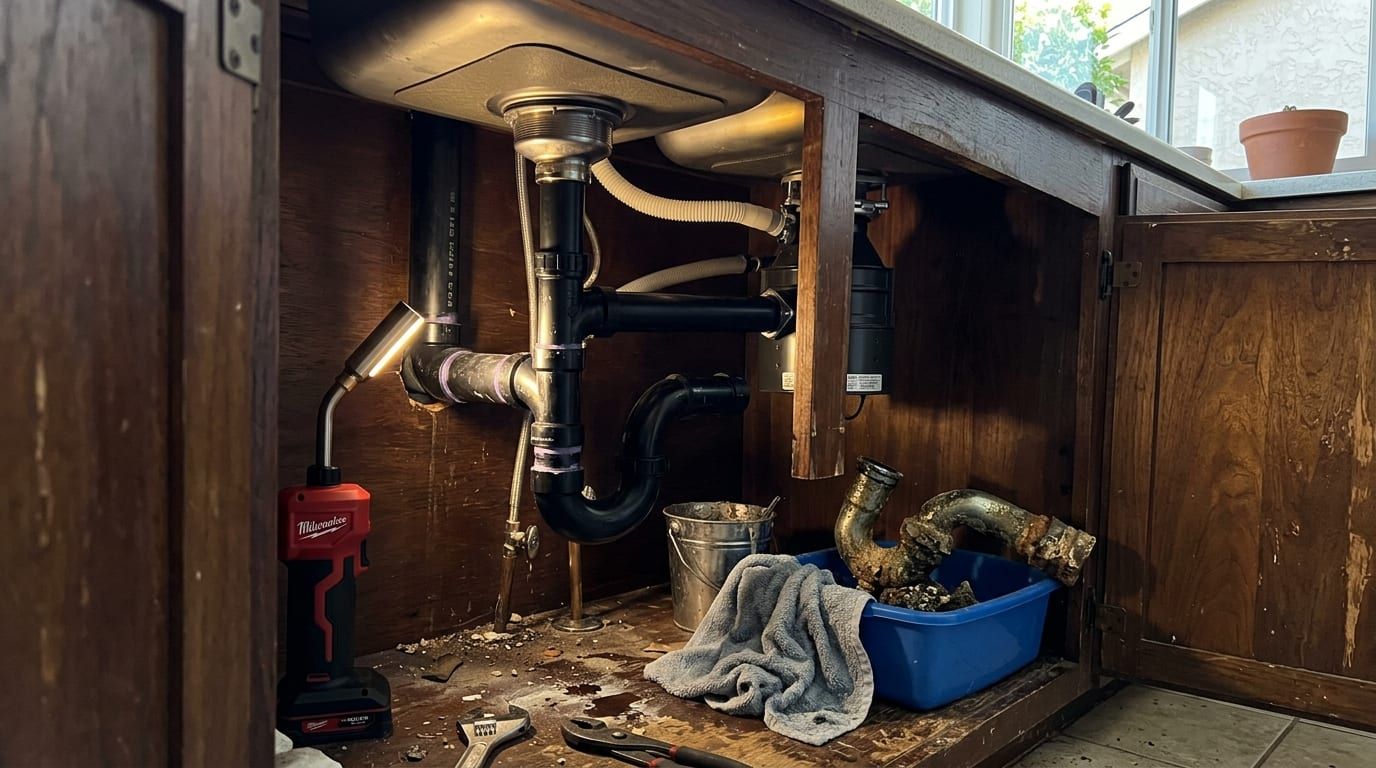
Work in this order. Bail the standing water down to a couple of inches, seal the second bowl and the dishwasher connection, then plunge with a flat cup plunger for a solid thirty seconds. If nothing shifts, put a bucket under the P-trap and take the trap off, because most kitchen blockages are within two feet of the sink. If the trap comes off clean and the arm behind it is blocked, a hand auger is next. What you should not do is pour a caustic drain cleaner in first, because it will still be sitting in the pipe when the trap opens.
Why the chemical goes back in the cupboard
Caustic drain products are sold for hair and soap, and a kitchen blockage is usually neither. It is cooled fat bound up with food solids, and the chemical sits on top of the standing water rather than getting into it. When it does react it generates heat inside a pipe that may be old ABS or scaled cast iron, and rubber washers in the trap do not enjoy that either. The larger problem is what comes next. If it fails, the sink is now full of a liquid that will run down a forearm the moment the slip nut turns. Anyone who opens that trap, you or a plumber, deserves to be told it is in there.
Five checks that take five minutes
Plunging a double bowl so it actually works
A plunger only works if the pressure has nowhere else to go. On a double bowl, the second drain is an open escape route, so it has to be blocked first. A wet rag pushed into the second drain with a weight on top will hold. Cover the working drain with the plunger cup, make sure there is enough water to cover the rim of the cup, and use short vertical strokes rather than one heavy shove. Break the seal deliberately on the last stroke instead of letting it pop off mid-stroke.
One caution before you start. If the dishwasher hose ties into the disposal without a high loop or a working air gap, plunging pushes water back towards the machine. A pair of pliers clamping that hose for the duration prevents a puddle under the appliance and takes ten seconds.
Taking the P-trap off without making a mess
Bucket under the trap, both slip nuts loosened by hand where possible, and expect the trap to be full whatever the sink looks like. Once it is off, look at what comes out, because the contents are the diagnosis. A grey plug of set fat with coffee grounds through it is a fixture problem and you have just fixed it. A trap that empties clean means the blockage is beyond it, in the horizontal arm running back into the wall. A trap with a crust bonded to the inside wall rather than a loose plug is a different message again, and it is the same message the branch line is sending.
How far a hand auger reaches, and where it stops
With the trap off, a small drum auger fed into the wall arm will reach the branch line and usually the point where it drops into the stack. That covers a large share of kitchen blockages. It will not reach the main sewer line, and it will not do anything useful if the arm is old galvanised steel that has scaled down to a narrow bore, where forcing a cable can find a weak spot rather than the blockage. Feed it in with steady rotation, and if it stops hard at a fixed distance every attempt, stop and note the distance. That number is genuinely useful to whoever comes next.
Why kitchen lines in older Costa Mesa houses close up again
Fat leaves the sink as a warm liquid and arrives somewhere downstream as a solid. What it sticks to depends on the pipe. In a house from the county’s mid-century wave, and the median Costa Mesa build year is 1972, the kitchen branch is likely cast iron with a rough, scaled bore. Mesa Water District supplies most of Costa Mesa entirely from local groundwater drawn from nine wells, and groundwater carries minerals. Mineral deposits and soap residue build a surface with texture, and texture is what cooling fat grips. That is why a line in a 1972 house closes faster than the same line in an Irvine house from 2002 with smooth ABS.
When it stops being a kitchen problem
What gets asked when you call
Expect three questions: what you have already tried, whether anything caustic went down the pipe, and whether this drain has been cleared before. The third one shapes the visit. A first-time blockage on a kitchen line is a small job with a cable and it should be sold as one. A line on its third clearing in a year is a question about the pipe, and the way to answer it is a camera rather than another cable. The difference between cutting a channel through a blockage and scouring the pipe wall back to bare material is covered in its own article, and it is worth reading before agreeing to the second cleaning.
If you do clear it yourself, write the date somewhere inside the cupboard door under the sink. Run cold water rather than hot afterwards, because hot water only moves softened fat further down the line to a place where it cools anyway and where nobody can reach it with a bucket and a pair of hands.