
Emergency plumbing
Is it one blocked drain or your whole sewer line?
The difference decides everything: who you call, what it costs, and whether the same thing happens again in three weeks. It is also easy to tell, once you know what to look at.
The test that separates them
A local blockage affects one fixture. A main line blockage affects everything downstream of it, which in a single-storey house is usually everything.
Run the washing machine and watch the nearest shower. Flush a toilet and listen to the basin next to it. If water rises somewhere else when you drain something here, the two are sharing a line that cannot cope — and that shared line is the problem.
Signs it is the main line
Signs it is just that fixture
Where your responsibility ends in Costa Mesa
This surprises most people. The Costa Mesa Sanitary District treats the sewer lateral — the pipe from your building to their main — as private property, and their main is usually under the middle of the street. A failure in the parkway, under the kerb or beneath the asphalt is still the property owner’s to repair.
The district also runs a rebate programme for a CCTV inspection of that lateral or the installation of a ground-level cleanout. If your line has backed up more than once, that programme is the cheapest way to find out why rather than paying to clear it again.
Stop adding water
While a main line is blocked, everything you send down it comes back at the lowest fixture. No taps, no washing machine, no dishwasher, nobody flushing. It sounds obvious and it is the single instruction people forget in the first ten minutes.
What clearing it actually involves
A cable clears a channel through the blockage and restores flow, which on a solid obstruction is exactly right. On the fifty-year-old cast iron under much of this city the blockage is often a lining of grease and scale rather than a lump, and a cable punches a hole through it that closes again.
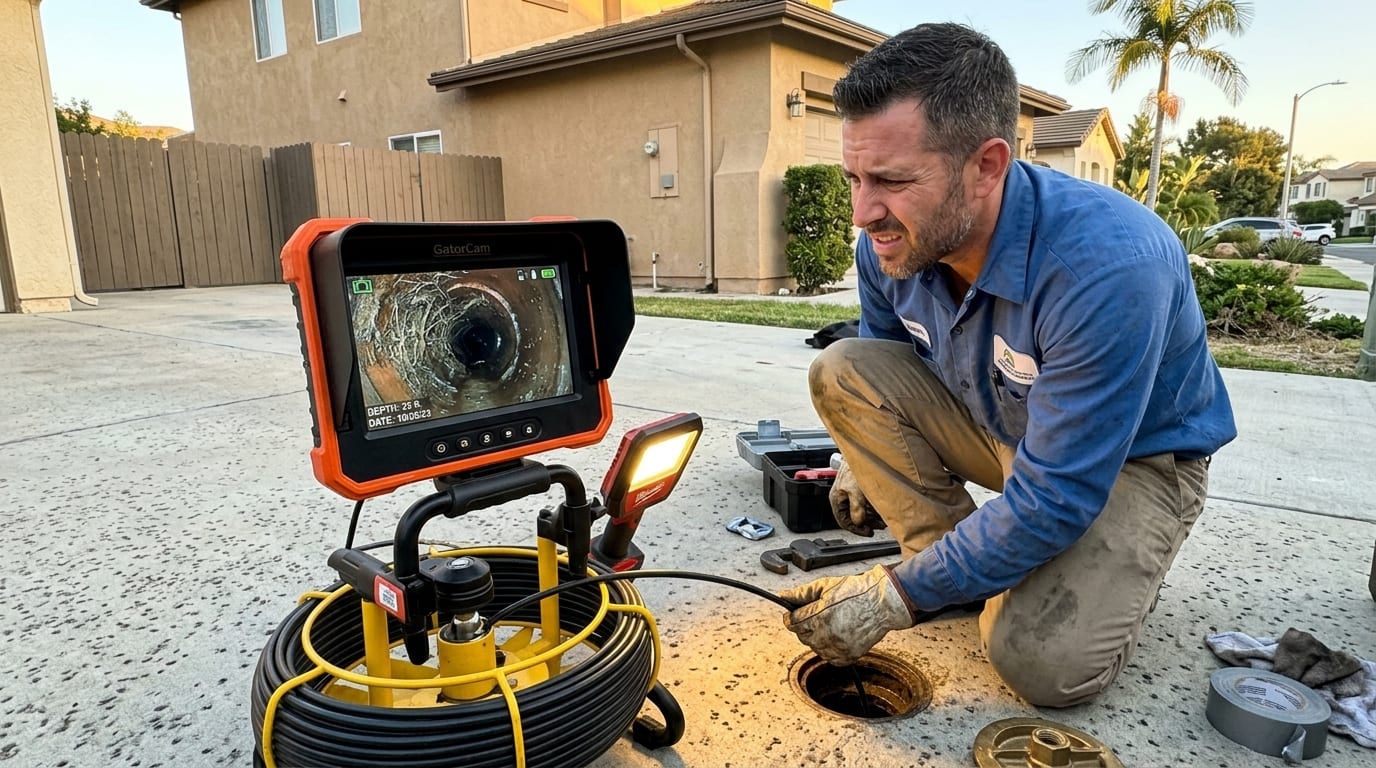
That is why we film the line after clearing it. The footage says whether you have a dirty pipe, a pipe with roots at a joint, a low spot holding water, or a section that has lost the bottom of the pipe — four situations that look identical from the plughole and need four different answers.
When it keeps coming back
A line that blocks on a rhythm is telling you something structural is holding solids. Roots enter through an opening that is still there after they are cut. A belly holds water at every flush. An offset joint catches everything that passes. None of those is fixed by clearing, and any plumber who keeps clearing without ever filming is selling you the same afternoon repeatedly.
What happens in the first hour on site
The first job is access, not clearing. A cleanout in the yard or against the foundation lets a cable and a camera travel both directions, towards the house and towards the street. Where no cleanout exists, the entry point becomes a pulled toilet, which is slower, messier and harder on your flooring for exactly the same result.
Then the line is opened at the lowest point so the house stops holding waste water, and only after flow returns does anyone recommend anything. Clearing first and diagnosing second is the correct order, not a shortcut: no camera reads a pipe through standing sewage.
Cable or jet, and how that gets decided
A cable cuts and pulls. It is the tool for roots, for a hard obstruction, and for getting a house with no working toilet back in service quickly. A jet scours: high-pressure water works the full circumference of the pipe and takes grease, soap and soft scale back to bare material, restoring the original bore instead of a channel through the middle of it.
The evidence for choosing is the footage. Grease lining a kitchen branch, or a flat run of cast iron furred all the way round, is a jetting job. Roots at a clay joint want cutting first and then a hard look at the opening the roots came in through. A section that has already lost the bottom of the pipe is neither, because putting pressure into a failed run is how a slow problem becomes an open trench the same afternoon.
What the camera tells you, and what it does not
Film answers four questions: what is in the pipe, what the pipe is made of, where along the run the trouble sits, and how deep it lies. A transmitting sonde in the camera head puts a mark on the ground above the defect and a depth to go with it, which is what turns somewhere under the front garden into a spot you can stand on.
What film cannot do is see through water. A belly holding standing water hides its own floor, so the line has to be jetted or drained before the picture means much. Read the footage for what is actually visible and treat the rest as unmeasured rather than fine.
Ten minutes that make the next backup easier
What not to do while you wait
Do not tip a caustic drain product into a main line. It will not travel to a blockage at the far end of the lateral, it stays as a hazard in whatever comes back up through the lowest fixture, and it makes the pipe dangerous for the person who has to open it. If some has already gone down, say so on the phone rather than after.
Do not lift the cleanout cap unless you are ready for what is behind it. A blocked line under a full house holds a head of water, and on a sloping lot that cap can be holding sewage back at waist height. And do not feed a garden hose down the pipe hoping to push the blockage along, because you are adding to a volume that already has nowhere to go, which is the same mistake as flushing again.