
Emergency plumbing
How to stop an overflowing toilet before it reaches the hallway
The water is rising, the flush is still running, and the instinct is to flush again. Do not. Here is the thirty seconds that actually stops it.
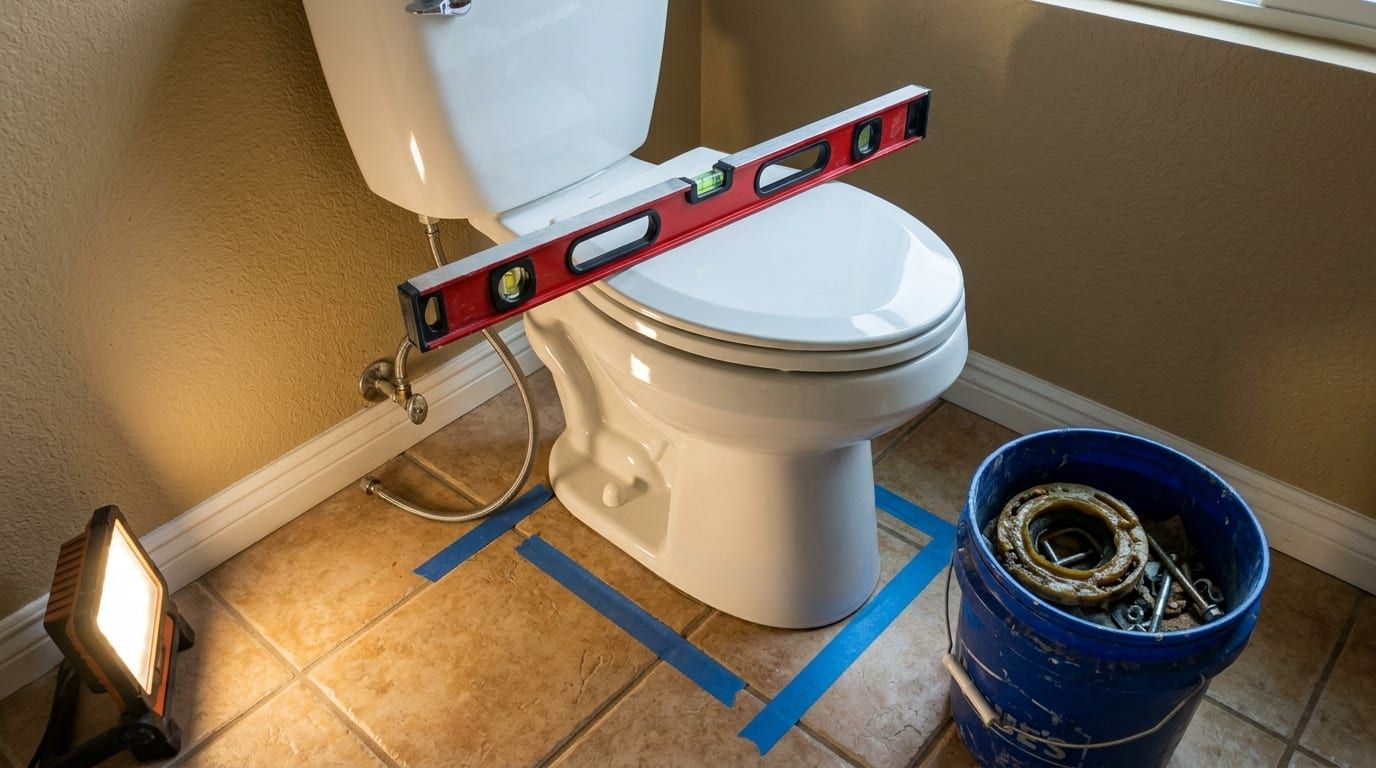
Second one: lift the tank lid
Take the lid off the cistern and push the flapper down — the rubber disc at the bottom of the tank sitting over the outlet. That stops water leaving the tank for the bowl immediately, which is what is actually feeding the overflow.
If the tank is still filling, lift the float — the ball or the cylinder on the fill valve — and hold it up. That stops the tank refilling. Two hands, ten seconds, and the water in the bowl stops rising.
Second ten: close the angle stop
The angle stop is the small oval or football-shaped valve on the wall behind the toilet, where the flexible supply line meets the pipe. Turn it clockwise until it stops. Now nothing can enter the toilet at all and you can put the lid down and think.
If the valve will not turn — common in Costa Mesa houses where it has not moved in twenty years — do not force it until the stem snaps. Go out to the meter box in the parkway and close the main instead.
Do not flush again
It is the most natural thing to do and it is the move that puts water on the floor. A blocked bowl does not clear because more water arrives; it simply overflows sooner. The second flush is almost always the one people regret.
Clearing it yourself
A flange plunger — the type with a soft rubber sleeve that folds out of the cup — is the right tool. The flat cup sold for sinks does not seal a toilet outlet and will not build pressure.
Seat it fully over the outlet, make sure there is enough water in the bowl to cover the cup, then push and pull with steady strokes rather than one violent shove. The pull matters as much as the push: you are rocking the blockage loose, not driving it further in.
If ten or fifteen strokes do nothing, stop. What comes next is a closet auger, which is a short cable with a protective sleeve designed to go through the trap without scratching the porcelain. A drain snake from a hardware shop will mark the bowl permanently.
Never pour drain cleaner into a blocked toilet
It does not clear the blockage. It sits in the standing water, it does not reach whatever is stuck in the trap, and it makes the bowl dangerous for anyone who has to plunge, auger or remove the toilet afterwards — including the plumber you are about to call. If you have already used it, say so on the phone.
Is it the toilet, or the line?
This is the question that decides whether you have a five-minute job or a real one. Check the other fixtures while the toilet is out of action.
Why the same toilet keeps blocking
A toilet that blocks once has swallowed something. A toilet that blocks every few weeks is reporting a problem further down, and replacing the fixture does not fix it. There are three usual explanations.
The branch line is narrowed
In a Costa Mesa house built before 1980 — two thirds of them — the waste line is often cast iron. Decades of build-up narrow the bore until an ordinary flush no longer clears it. The pipe is not blocked; it is smaller than it was.
Something is caught in the trap
Wipes, cotton products and paper towel snag on anything rough inside the trapway and then catch everything that follows. Wipes marketed as flushable do not break down in a lateral, whatever the packet says.
The main line has a structural problem
Roots at a joint, a low spot holding water, or an offset section will each produce a recurring blockage at the fixture closest to them. None of those is solved by clearing, which is why we film the line rather than clearing it a third time.
After the water stops
Once the bowl is under control, deal with what the water touched. Waste water on a floor is a health matter, not just a mess: gloves, a disinfectant, and anything porous that was soaked — a bath mat, the bottom of a skirting board, cardboard stored in a cupboard — treated on the assumption it is contaminated.
And check the floor around the base of the toilet over the following days. A toilet that has overflowed once often turns out to be one that rocks slightly, and a rocking toilet has usually broken its wax seal — which means it has been leaking under the floor for a while, quietly, long before the day it embarrassed itself in public.
What happens when someone comes out to it
The first question asked is what has already been tried, and it is not small talk: a bowl with chemical in it changes what can safely be done next. Then the bowl is augered from above, since a closet auger reaches the whole trapway and recovers what a plunger can only rock.
If the auger comes back empty and the bowl still will not clear, the toilet comes off the flange. That sounds drastic and is often the quickest honest route: it puts eyes on the trapway and the top of the branch, and the fixture goes back on a fresh wax seal. If that branch is clear and water still backs up, the line gets filmed before anything larger is proposed.
Ten minutes that prevent the next one
What a weak flush is really telling you
Not every repeat overflow is a blockage. A flush is a volume of water arriving fast enough to carry the contents over the weir of the trap; anything slowing that arrival mimics an obstruction. Mineral from the local groundwater builds up in the rim holes and siphon jet of an older bowl until only part of the water reaches the trap, and that bowl blocks on a load a healthy one clears.
A bucket separates the two: tip a couple of gallons in fast, bypassing the tank. If the bowl clears cleanly, the drain is fine and the fault is on the supply side of the flush: tank level, flapper, fill valve or rim. If it backs up, the problem is downstream and no work on the cistern will change it.